Masters 2026, Round 2: McIlroy Sets the 36-Hole Record and Now Leads by Six — Augusta National Has Never Looked This Manageable for One Player
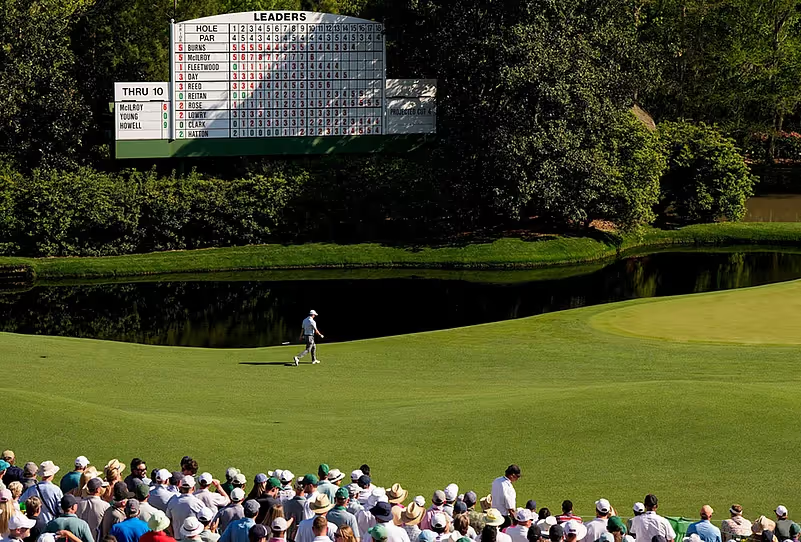

The number is six. Six shots, at the halfway point of the Masters Tournament, at Augusta National Golf Club, where six-shot leads are not supposed to exist because this course is specifically designed to prevent them. Rory McIlroy shot a 7-under 65 on Friday — capping the round with four consecutive birdies in a closing stretch that produced the kind of gallery noise Augusta reserves for something genuinely exceptional — and now leads the 90th Masters Tournament by a margin that has no historical parallel at the 36-hole mark.
The largest 36-hole lead in Masters history. In golf, that phrase carries the appropriate weight. There have been 89 previous Masters. The previous record was five shots. McIlroy beat it by one. He is 14-under through two rounds. The closest player to him is Cameron Young at 8-under. Six shots. At Augusta. With two rounds left.
The Round That Built the Record
McIlroy's 65 was not a product of Augusta playing especially easy on Friday — the greens had firmed from Thursday's softer conditions, and several players who had contended early found themselves going backward in the second round. What it was, instead, was a product of McIlroy playing a version of Augusta golf that the course is not set up to stop: long enough to reach the par-5s easily, precise enough with his irons to control which part of the greens he landed on, and patient enough on the front nine to set up the kind of back-nine run that defines signature Masters rounds.
The closing stretch — four birdies on his last four holes — is the sequence that will be replayed indefinitely. He birdied 15 from eagle range, 16 from 11 feet on a pin position that was tucked dangerously close to the water, 17 with a high iron that held its line against the breeze, and 18 from 10 feet to send the gallery into the kind of extended, sustained applause that the 18th at Augusta reserves for moments that feel permanent. Six birdies in a stretch of seven holes at Augusta. In the Masters.
What Six Shots Actually Means
Let's be fair to the history of this tournament and be precise about what a six-shot lead at Augusta National does and does not mean. It does not mean McIlroy has won. Augusta's history is full of leads that evaporated — most memorably in 1996, when Greg Norman took a six-shot lead into Sunday's final round and shot 78. Norman's collapse is the reason commentators reach for caution when discussing large Masters leads, and the reason players in the chasing group allow themselves to remain hopeful.
What the six-shot lead means in the practical sense is this: for every shot McIlroy gives back over the next two rounds, his opponents have to gain one. If he plays Saturday's third round in even-par and produces a 72, his lead becomes something like two shots. That requires the field to collectively play at 4-under or better. On Augusta National in the third round, with pins in positions that are specifically designed to pressure the leaders, that is not a trivial requirement.
The lead is significant. The lead is historically significant. The lead is not a guarantee. These three statements are all true simultaneously and do not contradict each other.
Young's Position and What the Leaderboard Says
Cameron Young at 8-under, six back, is the second-most interesting number on the Friday leaderboard. Young won The Players Championship. He is in the best form of his career. He has the ball-striking to contend at Augusta and has shown, repeatedly this season, the ability to chase down leaders who are ahead of him. Six shots is a lot. Six shots is not unsurmountable if McIlroy has any kind of Saturday that resembles what Norman had in 1996.
Scheffler is at 7-under. Patrick Reed is at 6-under. Sam Burns faded slightly to 5-under. The cut will fall somewhere around 3-over, and the players who survive into the weekend will spend Saturday trying to decide whether to chase McIlroy or simply play their own games and wait for the lead to come to them. Given what Augusta does on moving day, the latter strategy is probably wiser.
McIlroy leads by six. The record is his. Augusta National has two more rounds left to say its piece about whether that matters.