Pochettino Takes Over: What His USMNT Hiring Means for the 2026 World Cup
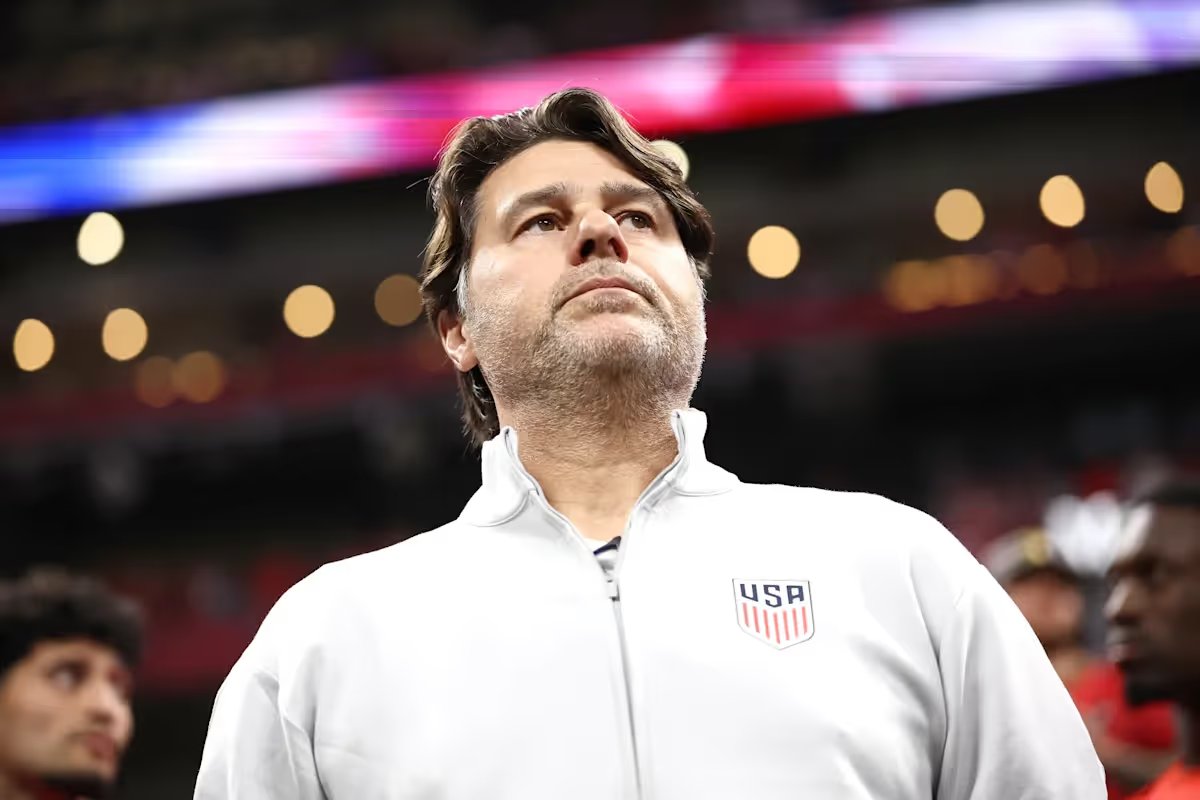

The Hire That Changes Everything
On September 10, 2024, U.S. Soccer finally did it. After years of cycling through coaches, enduring the humiliation of a Copa América group stage exit, and fielding questions about whether this program was actually built to win on the biggest stage, the federation went out and hired the most decorated manager in its history. Mauricio Pochettino — the man who took Tottenham Hotspur to a Champions League final, built PSG into a continental force, and survived the pressure cooker that is Premier League management at Chelsea — is now the head coach of the United States men's national team.
Let that sink in for a second. This is not a Gregg Berhalter retread. This is not a safe domestic hire. This is a $6 million-per-year deal — the richest in USSF history — for a manager who has coached some of the best players on the planet and done it at clubs where losing was never an option. The message from sporting director Matt Crocker couldn't have been clearer: the era of acceptable mediocrity is over.
Why Pochettino, Why Now
The timing of this hire was shaped entirely by the disaster in Atlanta. When Panama — a team the USMNT had historically dominated — walked out of Mercedes-Benz Stadium with a 2-1 Copa América group stage win, it wasn't just a bad result. It was an indictment of everything Berhalter had built in his second stint. The subsequent 1-0 loss to Uruguay eliminated the United States from a tournament hosted on their own soil for the first time in program history. Crocker didn't wait long. By July 10, Berhalter was out. By September 10, Pochettino was in.
The Argentine's CV is extraordinary by any standard, but particularly by USMNT standards. He transformed Southampton from a mid-table English club into a Premier League fixture. At Spurs, he spent five seasons building one of the most attractive teams in Europe — reaching the 2019 Champions League final while operating on a fraction of the budget his rivals enjoyed. At PSG, he managed an attack featuring Neymar, Messi, and Mbappe. At Chelsea, he turned a squad in genuine disarray into a sixth-place finish before both parties agreed to part ways. Whatever the results, the man has been at the center of elite European football for over a decade. Nothing about coaching Christian Pulisic and Weston McKennie is going to rattle him.
A Deal Built on Ambition
According to reporting from ESPN, the two-year deal worth approximately $6 million annually required negotiation over an exit fee from Pochettino's Chelsea contract — Chelsea owner Todd Boehly ultimately agreed to release the Argentine after reaching a financial settlement. That process delayed the official announcement by several weeks after reports first emerged in August 2024, but the USSF held firm. They wanted Pochettino. They got Pochettino.
When the announcement came, Crocker framed it in terms that left no room for interpretation: "Mauricio is a serial winner with a deep passion for player development and a proven ability to build cohesive and competitive teams." His track record speaks for itself, and there was genuine confidence within the federation that Pochettino could harness what is objectively one of the most talented USMNT generations in program history.
Christian Pulisic, who was among the first players to publicly react, called the hire "good news" in comments made before a Serie A match with AC Milan. "I think it's for a change and for us to take another step and really improve as a team," Pulisic said. His AC Milan teammate Yunus Musah echoed the sentiment, pointing to Pochettino's European pedigree as a mark of prestige the program sorely needed. When the players are this excited about a coaching change, it matters.
The Framework He's Walking Into
Pochettino inherited a squad that is simultaneously talented and inconsistent — a group with genuine stars at the top of the lineup and real questions about depth and system. Pulisic, McKennie, Tyler Adams, Antonee Robinson, and Sergiño Dest are all European-based players with significant experience at high-level clubs. Folarin Balogun's commitment to the United States added firepower up front. The pieces exist for something special. The question Berhalter never fully answered was how to make them work together under pressure.
That is Pochettino's primary job. His first match in charge came on October 12, 2024 — a 2-0 friendly win over Panama. It was a modest beginning, but the subtext was enormous: the new era had started. The style of play, the intensity in training, the tactical structure Pochettino brings — these are all factors that will take time to fully implement. But time, in this context, is measured against a hard deadline. The 2026 World Cup kicks off in June. Every match from October 2024 forward is a data point, a test, a step toward the roster and the system that will represent the United States on home soil.
What Success Actually Looks Like
Here's the uncomfortable truth that comes with this hire: the expectations have been recalibrated upward, and that's a double-edged sword. When U.S. Soccer was content with scrappy wins and moral victories, disappointment was manageable. Pochettino changes that calculus. You don't pay the most expensive coach in program history to win friendlies or sneak through the Nations League. You pay him to make a real run at the World Cup — the one being played in Los Angeles, Dallas, New York, and Kansas City, on fields where American fans will show up in massive numbers expecting something to cheer for.
The fourth-place Nations League finish in March 2025 and the Gold Cup runner-up result in July 2025 showed both promise and real gaps. Pochettino is building something — that much is clear. Whether it's built to win in June 2026 is the only question that will ultimately define his legacy with this program.
Why This Matters for the USMNT's Future
The Pochettino hire is a statement that the USSF is treating 2026 not as an opportunity to participate but as an opportunity to compete. For a program that has spent two decades trying to legitimize itself on the world stage, that distinction matters enormously. If Pochettino can take this group deep into a home World Cup — quarterfinal, semifinal, or beyond — it would do more for American soccer's long-term growth than any infrastructure investment or youth development program. The whole country is watching. So is the world. Pochettino was hired to make sure the result is worth watching.