Rory McIlroy Makes Masters History: Back-to-Back Green Jackets, Six Major Championships, and the Shot on 12 That Decided Everything
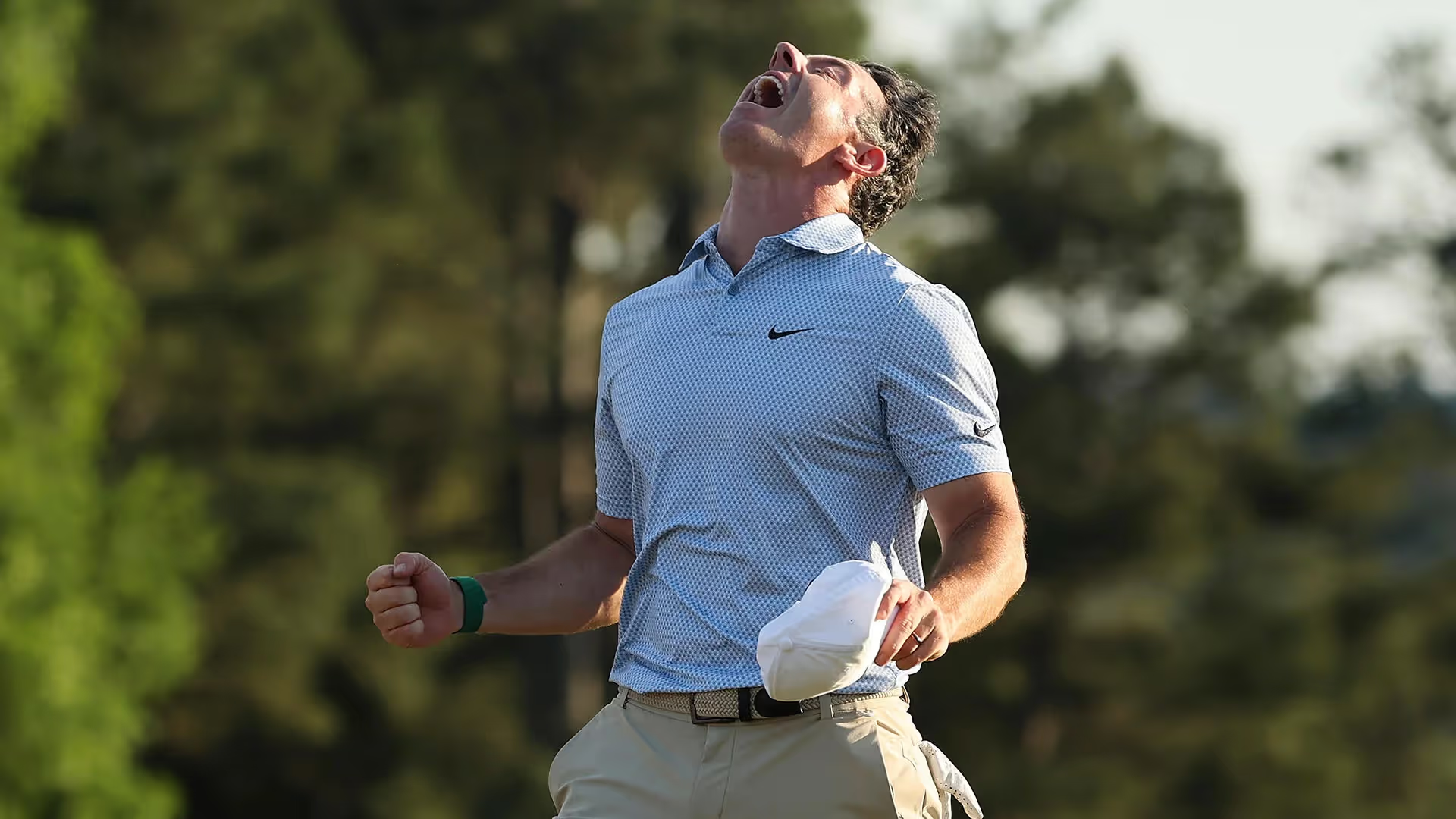

The 12th hole at Augusta National is 155 yards of pure terror. The pin was tucked just over the front bunker. The water in Rae's Creek was waiting for anything short. The wind, which at Augusta's par-3 12th can shift three times in the span of one swing, was doing exactly that. And Rory McIlroy, who had started the final round of the 2026 Masters two shots behind the man he needed to beat and had spent nine holes rebuilding his confidence and his footing, stood over the shot that would define his Sunday — and possibly his career — and pulled the trigger.
The ball flew over Rae's Creek, landed on the green, tracked toward the hole, and came to rest seven feet above the cup. McIlroy made the birdie putt. He walked to the 13th tee leading the Masters for the first time since Saturday morning. He did not give the lead back. He won his second consecutive green jacket, joined Jack Nicklaus, Nick Faldo, and Tiger Woods as the only players in 90 years to win back-to-back Masters titles, and earned his sixth major championship in a final round that will be discussed for decades.
The Front Nine Scare
McIlroy did not come out Sunday hitting the ball the way you want to hit it in a major championship final round. His front nine was tentative in places — an approach on the 5th that missed badly, a missed six-footer on the 8th for bogey — and by the time he made the turn, Cameron Young had taken a two-shot lead and McIlroy was doing something he has done before at Augusta National: watching a lead disappear from the wrong direction.
But this was not 2011. McIlroy in 2026 is a player who has the architecture of a champion rather than the potential of one, and the difference between those two things is exactly what the back nine revealed. He didn't force anything on the front nine. He made pars. He waited. He arrived at the 12th hole having lost ground, having absorbed the gallery's energy shifting toward Young, and having done absolutely nothing to put the tournament out of reach.
And then he hit the shot.
Amen Corner and the Moment That Changed the Tournament
The shot on 12 was 155 yards. McIlroy took what broadcast analysis later confirmed was an iron one club longer than the distance suggested, accounting for the wind and the consequences of being short. He hit it with the kind of aggressive commitment that is only possible if you've fully accepted what happens if it doesn't work. It worked.
Seven feet above the hole. Birdie putt going left-to-right. One of the most pressure-saturated putts in the modern Masters era. He made it. The gallery noise at Augusta's 12th green is acoustically unlike any other gallery anywhere in professional golf — the bowl that the hole sits in amplifies crowd reactions into something almost physical — and the response to that birdie putt landing at the bottom of the cup was the loudest single moment at Augusta National in years.
He followed it on the 13th with a drive that the official measurement listed at 350 yards, leaving him a mid-iron to a par-5 that was supposed to be a challenge. He made birdie from the approach. Two holes: birdie, birdie. The lead had gone from minus-two to plus-one in the space of two extraordinary golf holes. Young, playing in the same group, made par on both. The tournament had turned.
The Finish
McIlroy played the final five holes at 1-under and finished at 12-under par, closing with a 71. Scottie Scheffler's Sunday 67 brought him to 11-under and a runner-up finish — the third time in 2026 that Scheffler had finished second, which is a remarkable achievement that somehow keeps reading as a disappointment given his talent. Young finished third at 10-under, his 69 on Sunday representing a strong round by most standards and an insufficient one by the standards this week required.
For the record: Nicklaus won back-to-back in 1965-66. Faldo won back-to-back in 1989-90. Woods won back-to-back in 2001-02. McIlroy joins that list. He is now in the company of the three most dominant major champions of their respective eras. The framing is not accidental. The framing is earned.
What This Does for His Legacy
Six major championships. Two Masters. One U.S. Open. One Open Championship. Two PGA Championships. He is 36 years old and playing the best golf of his life. The conversation that has followed McIlroy for a decade — about his relationship with Augusta, about the ghosts of 2011, about whether he would ever win here — has been rendered not just resolved but overrun. He has won here twice. The second time, he won it in the hardest possible way: from behind, with a shot that required everything he's learned in a career spent preparing for moments exactly like it.
There was a specific silence in the Butler Cabin when Fred Ridley helped McIlroy into the green jacket — the silence that comes just before the applause, when the significance of a moment is so clear that the crowd hasn't quite caught up to it yet. McIlroy stood there, in the jacket, and the silence held for a beat longer than it usually does.
Some things take a moment to land properly. Back-to-back Masters titles. A sixth major. The shot on 12. A career that has arrived, definitively, at exactly the place it was always supposed to.