Scouting Paraguay: What the USMNT’s World Cup Opener Actually Looks Like

Not a Walkover. Not a Nightmare.
The narrative around Paraguay in the USMNT’s Group D matchup tends toward one of two poles: either they’re dismissed as a pushover that the Stars and Stripes should handle comfortably on home soil, or they’re built up as a physical South American side capable of ruining the opener. The truth, as it usually is, sits somewhere between those two framings — and understanding where exactly requires looking at what Paraguay actually is rather than what the narrative says they are.
Paraguay enters the 2026 World Cup ranked in the high 30s of the FIFA rankings. They qualified for the tournament out of a CONMEBOL qualifying campaign that tests teams across some of the most difficult environments in international football — altitude in Bolivia and Ecuador, the noise of Buenos Aires, the humidity of Asunción. Teams that survive CONMEBOL qualifying have something to offer. Paraguay’s competitive identity under their coaching setup is built around defensive organization, physical intensity in duels, and set-piece threats in both directions.
The November Friendly Result and What It Actually Told Us
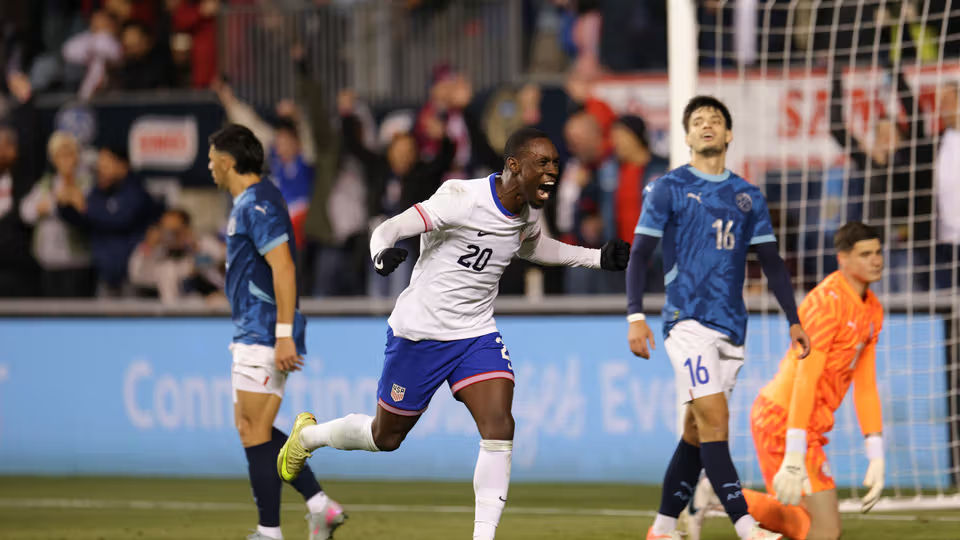
The USMNT beat Paraguay 2-1 in a November 2025 friendly at Subaru Park in Chester, Pennsylvania. That result is relevant but limited in its predictive value. Paraguay’s approach in a pre-tournament friendly differs significantly from their approach in a World Cup group stage opener where the stakes are the highest they will ever be for many of those players. The physical intensity, the defensive compactness, the willingness to play for a 0-0 draw if that’s what the game demands — all of these will be cranked higher in June than they were in November.
The key takeaways from the friendly: Paraguay pressed high in the first 20 minutes before settling into a more organized defensive shape. The central strikers they deploy are physical enough to make life uncomfortable for the USMNT’s three-man center back unit. Their counter-attacking threat on the right side exploited the wingback-heavy defensive structure at least twice during the match. The USMNT’s 2-1 win was genuine but required a composed defensive performance to manage the moments when Paraguay had genuine momentum.
The Keys for the USMNT
Against Paraguay, the tactical priorities for the United States are specific. First: establish the press early and don’t allow Paraguay to settle into their defensive shape. Teams like Paraguay are significantly more difficult to break down when they have time to organize. Second: use the wingbacks — Robinson on the left, whoever starts on the right — to create numerical overloads wide before Paraguay’s defensive structure can adjust. Third: be ruthless on set pieces at both ends. Paraguay will threaten the USMNT’s box on dead balls, and the United States’ own set-piece delivery — from the corners and free kicks that Robinson and Berhalter can produce — is one of their most reliable goal-generating mechanisms.
The Crowd Factor
SoFi Stadium’s 70,000-plus capacity will almost certainly be predominantly pro-USA for the June 12 opener. That crowd advantage will affect Paraguay’s players just as much as it will energize the Americans. The pressure of playing in a hostile environment against a home team that has a national narrative behind it creates specific psychological challenges for the visiting side. Paraguay’s coaching staff will know this. Their preparation will emphasize staying organized, minimizing mistakes, and making the crowd’s enthusiasm irrelevant by keeping the score level long enough for the atmospheric pressure to work in their favor.
Why This Matters for the USMNT Going Forward
The Paraguay match is the most important game of the entire World Cup preparation cycle. Not because Paraguay is the best team the United States will face. Because it’s the first one. A confident win against Paraguay sends the message to the home crowd, to Australia and Turkey watching from a distance, and to the USMNT themselves that the system works under competitive pressure. An opening loss would change everything — the tension in the squad, the crowd’s energy, and the margin for error against Australia and Turkey. The World Cup starts on June 12. Everything before it was preparation.