The 2026 World Cup Home Field Advantage: What It Means for the USMNT to Play in Front of American Crowds

Something the Numbers Can’t Fully Capture
The home-field advantage at a World Cup is real and documented. Host nations have advanced from the group stage at roughly double the rate of non-host nations with similar FIFA rankings. They benefit from familiar stadiums, elimination of travel fatigue between matches, crowd support that creates the kind of sustained noise and energy that affects how opponents make decisions under pressure, and the psychological weight of representing a home country in front of a home audience. All of that applies to the USMNT’s June group stage run in Los Angeles and Seattle.
But there’s something about this particular World Cup and this particular home-field advantage that the numbers can’t fully capture. The United States is co-hosting a 48-team World Cup on soil where soccer is still growing as a major professional sport. The crowds that will fill SoFi Stadium for Paraguay and Seattle’s Lumen Field for Australia will not just be loud. They will be transformative for many of the American players in terms of what they understand about what this sport can mean in their own country.
The SoFi Stadium Experience
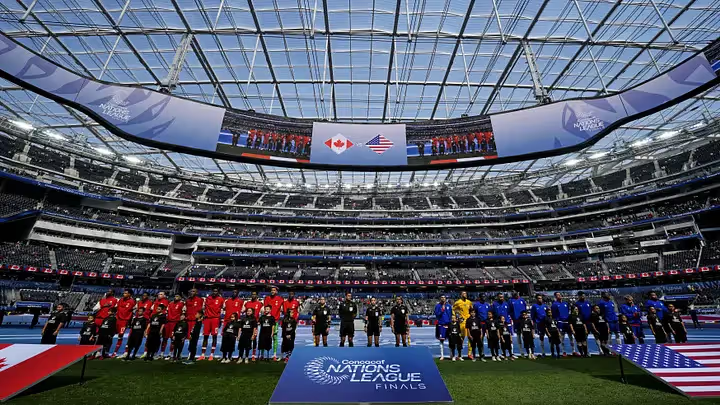
SoFi Stadium, which opens the USMNT’s World Cup run on June 12, is the most technologically advanced football venue in North America. The roof, the acoustics, and the seating configuration create an environment where crowd noise doesn’t dissipate outward the way it does in open-air venues. The capacity for the World Cup configuration will be well over 70,000. With a crowd that will be overwhelmingly American — and specifically Southern California American, which means a diverse, soccer-knowledgeable fanbase that includes large MLS and Liga MX followings — the atmosphere for the Paraguay match will be unlike anything this squad has experienced in competitive play.
Pulisic has played in big European club atmospheres. McKennie has experienced Juventus’ intensity and Tottenham’s noise. Adams plays Premier League football regularly. But none of that is the same as playing a World Cup match for your own country in your own country with tens of thousands of people in the stadium who have been waiting their entire soccer lives for this exact moment. That’s a different emotional frequency entirely.
The Challenge It Creates
Home field advantage cuts both ways. The crowd support is real, but so is the pressure of the expectation. When the USMNT concedes a goal against Paraguay at SoFi, the silence will be deafening in a way that silence at a neutral-site match would not be. The players will feel the weight of the home crowd’s disappointment in real time and will need to respond to it rather than be paralyzed by it. Managing that emotional dynamic is part of what Pochettino’s preparation has to address — not through panic, but through the kind of composed, structured performance that doesn’t get rattled by the crowd going quiet.
The 2022 World Cup in Qatar, where the USMNT had strong crowd support but not a true home environment, provided some preparation for high-stakes competitive matches. The Gold Cup and Nations League finals also contributed. But June 2026 will be categorically different. The pressure is real. So is the opportunity.
Why This Matters for the USMNT Going Forward
The home field advantage isn’t something the USMNT can control. It’s something they have to use. The crowds will be there. The passion will be there. The national attention will be there in a way that it never has been for American soccer. What the players do with all of that energy — whether they let it lift them or overwhelm them — will be one of the defining stories of the tournament. The opportunity is generational. The players who step up in front of their home crowds in June will be remembered by American soccer fans for the rest of their lives.