Stunned at SoFi: How Panama Ended the USMNT's CONCACAF Nations League Dynasty
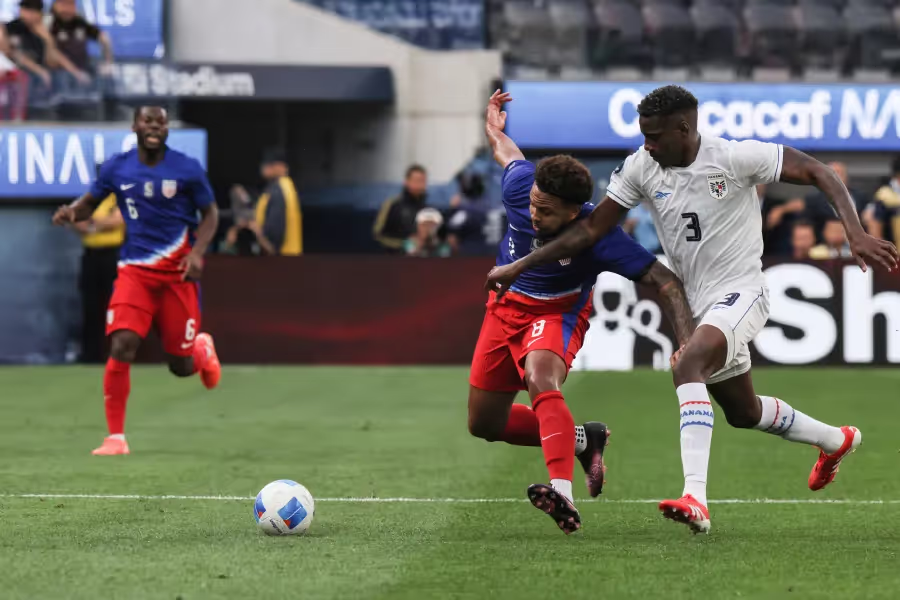

The Strike That Changed Everything
It happened in the fourth minute of second-half stoppage time. The United States men's national team had controlled large stretches of a tense CONCACAF Nations League semifinal at SoFi Stadium in Inglewood, California. The score was still 0-0. One shot on target — just one, for the entire match — had beaten Matt Turner, and it was the one that mattered. Cecilio Waterman received a pass from Adalberto Carrasquilla down the right side, stepped into space in front of a packed American defense, and rifled a perfect right-footed diagonal shot into the far left corner. Panama 1, United States 0. Final.
The dynasty was over. The United States had won the first three editions of the CONCACAF Nations League — 2021, 2023, 2024 — a run that had become one of the few reliable sources of competitive accomplishment for a program that struggled for consistency in other tournaments. On March 20, 2025, Panama ended all of that with a single shot. Waterman's goal was Los Canaleros' only shot on target all night.
The Tactical Reality
In some ways, this loss followed an increasingly familiar script for the USMNT against Panama. The Americans were expected to dominate possession — and they did. They were expected to create chances — and they had moments. Josh Sargent found the woodwork in the first half, and a Tim Weah offside call wiped out what appeared to be a well-taken Sargent goal. Tyler Adams — making his first national team appearance since the Copa América after recovering from back surgery — had a clean look from just outside the box in the dying seconds that sailed over the crossbar. All of it added up to a scoreless draw through 93 minutes.
Panama, under Thomas Christiansen, set up in a disciplined low block and made life difficult without necessarily threatening. Their game plan was clear from the opening minutes: absorb pressure, limit space, and wait for the right moment. When Waterman found that moment in stoppage time, it was the culmination of a perfect performance from a team that knew exactly who it was and what it needed to do.
For Pochettino and his staff, the more troubling element was the USMNT's inability to break down a low block when the opponent offered nothing in transition. This has been a recurring issue — the width wasn't there, the movement in the final third was too predictable, and the clinical finishing that wins tight matches simply didn't materialize. Pochettino said as much afterward: "I am very, very disappointed, because I think the way that we approached the game and started the game wasn't in the right way. We need to find a way to compete better."
The Injury Context
To be fair to the USMNT, they went into this match significantly undermanned. Sergiño Dest and Antonee Robinson — both starting-quality outside backs — were unavailable due to injuries. That's a meaningful absence in a match where width and defensive recovery are critical. The fullback positions were covered by players who performed adequately but didn't offer the same combination of attacking quality and defensive reliability that Robinson and Dest bring at their best.
Turner's performance was also a talking point. The match represented legitimate concerns about whether his limited playing time at club level was affecting his sharpness at the international level. Waterman's shot was struck well, but Turner's positioning on the far post shot has been dissected at length by analysts in the days since. It's a conversation the USMNT can't avoid heading into a World Cup.
What the Result Actually Means
The Nations League loss matters for two reasons that go beyond the trophy. The first is competitive momentum. Pochettino's first major competitive tournament as USMNT manager ended in a semifinal loss — then a third-place defeat to Canada, marking the first time Canada had beaten the United States back-to-back since 1985. That's a lot of losing to regional rivals in a short period. For a team with World Cup aspirations, the optics are difficult.
The second reason is tactical information. Panama beat the USMNT twice in major competition across roughly eight months — Copa América in 2024, Nations League in 2025. They've found a blueprint that works against this team. Pochettino's ability to address that blueprint is now a documented concern that will follow the program into 2026.
Panama's Moment
Credit where it's absolutely due: Panama's run to the Nations League final was extraordinary. Christiansen's team beat the defending three-time champion with a single shot on target and reached the tournament final for the first time in program history. Waterman's goal in stoppage time was the kind of strike that gets replayed on highlight packages for years. For a nation that has consistently punched above its weight in CONCACAF competition, this was a peak moment.
Why This Matters for the USMNT Going Forward
The end of the Nations League dynasty is a data point, not a death sentence. Pochettino's time as USMNT manager is still in its early chapters. The 3-4-3 formation he's been developing, the tactical adjustments he's made, and the roster depth he's built all point to a program that is actively evolving. But evolution takes time, and the calendar is unforgiving. The 2026 World Cup is just over a year away from this Nations League loss. If Panama — or any other regional rival — can neutralize this team again on that stage, the stakes will be incomparably higher than a trophy won in Inglewood.