Gotterup's Hot Start: Two Wins in Three Starts to Begin 2026
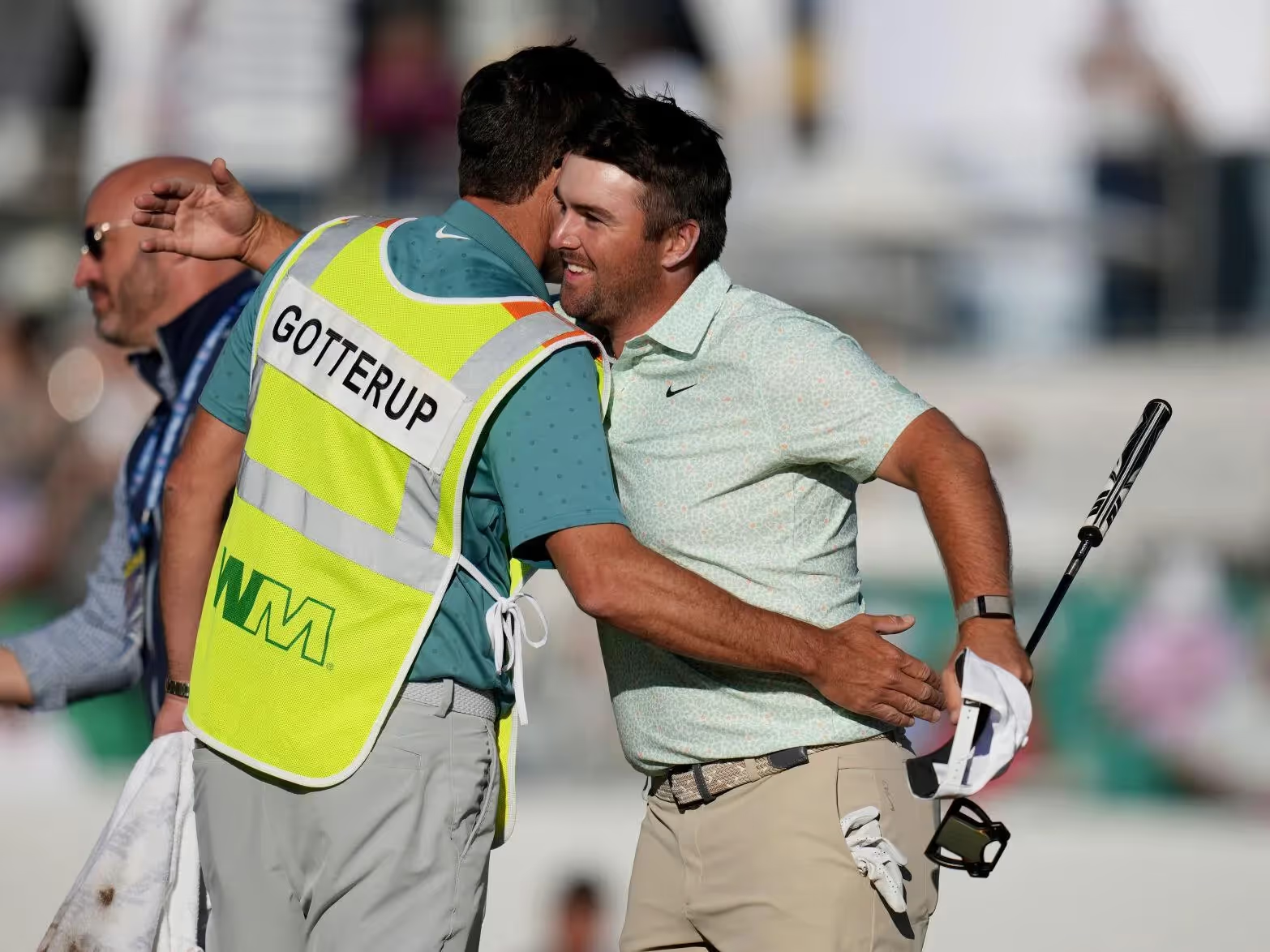

Chris Gotterup's meteoric rise to the top of professional golf wasn't supposed to happen this quickly. The 26-year-old from Holmdel, New Jersey, entered the 2026 season with modest expectations — maybe a top-10 finish or two, perhaps some momentum to build on for the rest of the year.
Instead, he's rewriting the script entirely.
With his playoff victory Sunday at the WM Phoenix Open, Gotterup has now won twice in his first three starts of the 2026 PGA Tour season, a feat that places him in rarified air alongside legends of the game. His hot start isn't just impressive — it's historic, and it's turning heads from Scottsdale to Augusta.
"I don't think I could have drawn it up any better," Gotterup said, still clutching the championship trophy after Sunday's thrilling playoff victory over Hideki Matsuyama. "Two wins in three starts? That's beyond my wildest dreams."
The Sony Open: Where It All Began
Gotterup's remarkable 2026 campaign began in Hawaii at the season-opening Sony Open in Honolulu. The tournament, traditionally one of the lower-profile events on the PGA Tour schedule, was the perfect stage for Gotterup to announce his arrival.
He entered the final round trailing by three shots but quickly erased the deficit with aggressive play on Waialae Country Club's front nine. By the time he made the turn, Gotterup was tied for the lead and playing with a confidence that belied his limited tour experience.
The back nine was where Gotterup truly shined. He birdied the 12th to take the lead outright, then added another at the par-3 13th to extend his advantage to two shots. When a brief stumble at the 14th dropped him back into a tie, Gotterup responded in the only way he knows how: with more birdies.
He converted a 15-footer at the par-4 16th to regain the lead, then sealed the victory with a clutch birdie at the closing hole — a 533-yard par-5 that rewards aggressive play but punishes mistakes.
"I felt comfortable all week in Hawaii," Gotterup said after that victory. "I was hitting it well, making putts when I needed to, and staying patient. That's a recipe for success on any course."
The final-round 63 was the best score of the day and gave Gotterup his first career PGA Tour victory. More importantly, it gave him the belief that he could compete with — and beat — the best players in the world.
"Winning my first tour event was incredible," Gotterup said. "But I knew I couldn't rest on my laurels. I wanted to keep the momentum going."
The American Express: A Brief Respite
After the euphoria of winning in Hawaii, Gotterup headed to the California desert for The American Express, a tournament played over three courses in the Palm Springs area. The unique format — three days of play across three different layouts, followed by a final round at the Stadium Course at PGA West — presents challenges that can trip up even the most experienced players.
For Gotterup, The American Express was a chance to reset and recalibrate. He played solid golf all week, posting four rounds in the 60s and finishing in a tie for 28th at 17-under par, eight shots behind winner Patrick Cantlay.
While the finish wasn't spectacular, it was exactly what Gotterup needed — a week of competitive golf without the pressure of contending for a title, a chance to work on his game and prepare for the challenges ahead.
"I played well enough at The American Express, just didn't make enough putts," Gotterup said. "Sometimes you need a week like that to remember what you need to work on. I went to the practice green after the final round and spent two hours working on my speed control. I knew that would be important going forward."
Little did he know just how important those practice sessions would prove to be at TPC Scottsdale.
The Phoenix Open: Redemption and Revelation
Arriving at TPC Scottsdale for the WM Phoenix Open, Gotterup was riding high on confidence from his Sony Open victory but also eager to prove that the win wasn't a fluke. The tournament, with its raucous crowds and party atmosphere, would provide the perfect test.
Gotterup's week started with a bang — an opening-round 63 that tied for the low score of the day and put him firmly in contention. The round featured eight birdies and just one bogey, and it showcased the aggressive, fearless style of play that has become Gotterup's calling card.
"I wasn't thinking about defending anything or protecting a lead," Gotterup said after Thursday's opening round. "I was just trying to make as many birdies as possible and see where that put me."
Friday's 71 was a step backward, but Gotterup remained patient, knowing that the Stadium Course would present plenty of birdie opportunities over the weekend. Saturday's 70 kept him in the mix, and he entered Sunday's final round five shots behind leader Hideki Matsuyama.
It was a deficit that would have seemed insurmountable just a few months ago. But this was a different Chris Gotterup — a player who had won in Hawaii with a closing 63 and knew he could go low when it mattered most.
Sunday's Defining Stretch: Five Birdies in Six Holes
If there was one sequence that defined Gotterup's 2026 season — and perhaps his entire career — it was the closing stretch at the WM Phoenix Open. Playing the final six holes in 5-under par, Gotterup authored one of the most memorable finishes in tournament history.
The run began at the par-5 13th hole, where Gotterup crushed a drive over 320 yards and followed with a precise 7-iron to 15 feet. The eagle putt just missed, but the tap-in birdie moved him to 12-under for the tournament.
At the par-4 14th — a relatively straightforward hole that measures 442 yards — Gotterup found the fairway with his tee shot and stuck an 8-iron to 12 feet. The birdie putt was never in doubt, tracking into the center of the cup to move him to 13-under.
The par-5 15th provided another birdie opportunity, and Gotterup took full advantage. After a good drive, he hit a fairway wood to the green and two-putted from 40 feet to reach 14-under. Suddenly, what had seemed like a long shot was becoming very real.
A par at the famous 16th hole kept Gotterup at 14-under, but it was at the driveable par-4 17th where he made his next move. With water guarding the left side of the green, Gotterup chose to attack with driver, and his ball found the front edge of the putting surface.
The two-putt birdie moved him to 15-under, and now Gotterup could sense that something special was happening. One more birdie at the par-5 18th would give him a final score of 16-under — a number that would put maximum pressure on the final groups.
Standing on the 18th tee, Gotterup knew what he needed to do. But the tee shot didn't go quite as planned, finding the right rough instead of the fairway. No matter — Gotterup had been in tough spots before and knew how to navigate them.
His second shot, from 175 yards out of the rough, was struck beautifully and found the green about 35 feet from the hole. The eagle putt never really threatened, but the lag was perfect, leaving just a 3-foot tap-in for birdie.
When the putt dropped, Gotterup raised his arms in triumph. He had posted 16-under par and given himself a real chance to win. Now all he could do was wait and see if it would be enough.
The Waiting Game
As Gotterup signed his scorecard and made his way to the range to stay loose, the drama on the course was just beginning. Matsuyama, playing in the final group with a one-shot lead, was struggling to find fairways but somehow staying in front through brilliant scrambling.
Gotterup watched on a television monitor as Matsuyama navigated the closing holes, each par feeling like a small victory for the Japanese star and a disappointment for Gotterup. When Matsuyama reached the 17th tee still holding a one-shot lead, it seemed like the championship was slipping away.
But then came the drama — Matsuyama's tee shot at 17 that nearly found the water, the awkward stance, the par that felt like a bogey. And then, on the 72nd hole, the drive into the bunker, the lip-out on the recovery, and finally the bogey that dropped Matsuyama back to 16-under.
Suddenly, improbably, Gotterup was in a playoff.
"I was trying to stay calm and not get too ahead of myself," Gotterup said. "But when I saw Hideki make bogey at 18, I knew I had a real chance. I tried to just focus on my routine and trust my game."
The Playoff: Power and Precision
The playoff was everything you could want in a sudden-death showdown — drama, tension, and a clear contrast in styles between the two competitors.
Matsuyama, who had struggled with his driver all day, needed one good swing to keep his hopes alive. But when a distraction in the crowd caused him to back off and reset, the pressure seemed to mount. His second attempt at the shot started left immediately and splashed into the water, effectively ending his chances.
Gotterup, meanwhile, was in complete control. His drive was massive — over 360 yards — and found the right side of the fairway with room to spare. From there, it was a simple matter of hitting a short iron to the green and making the birdie putt.
"I just wanted to put it in the fairway and give myself a chance," Gotterup said. "I knew Hideki was struggling with his driver, so if I could just hit a good one, I'd be in great shape."
The approach shot was struck beautifully, landing softly on the green about 27 feet from the cup. As Matsuyama conceded the hole and the tournament, Gotterup was left with a meaningless birdie putt — which he made anyway, just for good measure.
The Power Game: Gotterup's Biggest Weapon
If there's one aspect of Gotterup's game that sets him apart from the field, it's his prodigious length off the tee. At both the Sony Open and the WM Phoenix Open, Gotterup consistently bombed drives past his playing partners, giving himself shorter irons into greens and more birdie opportunities.
The numbers tell the story: At the WM Phoenix Open, Gotterup averaged 318 yards off the tee, ranking in the top 10 in the field. His longest drive of the week measured 385 yards, and he regularly carried fairway bunkers that lesser bombers had to lay up short of.
"Distance is a huge advantage in modern golf," Gotterup said. "If I can hit it 20 or 30 yards past my playing partners, I'm hitting 8-iron while they're hitting 5-iron. That makes a big difference over the course of four rounds."
But it's not just about raw power — Gotterup's accuracy off the tee has also improved dramatically. At the WM Phoenix Open, he hit 68% of fairways for the week, a solid number that shows he's learning to control his power rather than just unleashing it.
"I've worked really hard on my driver the last few years," Gotterup said. "It's not just about hitting it far — you have to hit it straight too. I feel like I'm finally figuring out that balance."
The Finishing Gene: What Separates Champions
But perhaps the most impressive aspect of Gotterup's early-season success is his ability to close. At both the Sony Open and the WM Phoenix Open, he saved his best golf for the final holes, making clutch birdies when he needed them most.
At the Sony Open, Gotterup birdied four of his final six holes to claim the victory. At the WM Phoenix Open, he birdied five of his final six to force the playoff and then close out Matsuyama.
That's a combined nine birdies in the final 12 holes of his two victories — a closing percentage that would make even Tiger Woods jealous.
"I think I've just gotten more comfortable in those pressure situations," Gotterup said. "The more you put yourself in contention, the more you learn how to handle the nerves and execute your shots. I feel like I'm starting to figure it out."
The mental side of closing has been just as important as the physical. Gotterup has worked with a sports psychologist to develop routines and breathing techniques that help him stay calm in pressure-packed moments.
"It's all about controlling what you can control," Gotterup said. "I can't control what my opponents do, I can't control the weather or the course conditions. But I can control my breathing, my thoughts, and my commitment to each shot. That's where I focus my energy."
The Financial Windfall
Gotterup's two victories have also secured his financial future for years to come. The Sony Open victory earned him $1.53 million, while the WM Phoenix Open win was worth $1.728 million. In just three weeks of work, Gotterup has earned over $3.25 million — more than many tour pros make in an entire season.
The FedExCup points are equally impressive. With 500 points for each victory, Gotterup sits atop the early-season standings with 1,000 points. He's essentially locked up his tour card for the next two seasons and positioned himself as a likely participant in this year's Signature Events — the high-purse, limited-field tournaments that attract the game's best players.
But for Gotterup, the money and points are secondary to the validation that comes with winning.
"The money is great, don't get me wrong," Gotterup said with a smile. "But what matters most is proving to myself that I belong out here, that I can compete with and beat the best players in the world. That's what drives me."
Historical Context: Rare Company
Gotterup's achievement of winning twice in his first three starts of a season places him in elite company. Only a handful of players in PGA Tour history have accomplished the feat, including names like Tiger Woods, Phil Mickelson, and Jordan Spieth.
Woods famously won the Mercedes Championships and the Buick Invitational in his first two starts of the 2006 season, then finished third at the Nissan Open before winning again at the Dubai Desert Classic. Mickelson won twice in his first three starts in 1996, while Spieth matched the feat in 2015 en route to his historic season that included two major championships.
"I'm not comparing myself to those guys — they're legends of the game," Gotterup said when the historical context was mentioned. "But it's pretty cool to be in that conversation, even if it's just for a moment."
What Makes Gotterup Different?
So what separates Gotterup from the dozens of talented young players trying to make their mark on the PGA Tour? According to those who know him best, it's a combination of work ethic, natural talent, and mental toughness.
"Chris is one of the hardest workers I've ever seen," said his college coach at Rutgers University. "He's always the first one to the range and the last one to leave. He's constantly trying to get better, whether it's his swing, his short game, or his mental approach."
Gotterup's natural talent is undeniable. His length off the tee gives him a significant advantage on most courses, while his iron play has improved dramatically over the past two years. His putting, once a weakness, has become a strength through countless hours of practice.
But perhaps most importantly, Gotterup has the mental fortitude to succeed at the highest level. He doesn't get rattled by bad breaks or poor shots, and he has a remarkable ability to stay in the present moment rather than getting ahead of himself.
"I try not to think about the outcome," Gotterup said. "I just focus on the process — picking the right club, visualizing the shot, and executing. If I do that enough times, the results will take care of themselves."
The Road Ahead: Can the Hot Streak Continue?
The question now is whether Gotterup can maintain this torrid pace. History suggests that hot streaks eventually cool off — even the best players in the world go through stretches where the putts don't drop and the breaks don't go their way.
But Gotterup isn't worried about the future. He's too busy enjoying the present.
"I'm just trying to take it one tournament at a time," he said. "I know I won't win every week — nobody does. But I also know that my game is in a good place, my confidence is high, and I'm excited about what's ahead."
The PGA Tour schedule over the next few months includes several marquee events where Gotterup will have a chance to add to his trophy collection. The Genesis Invitational at Riviera, the Arnold Palmer Invitational at Bay Hill, and the Players Championship at TPC Sawgrass all loom as potential victory opportunities.
And then there are the major championships — the Masters in April, the PGA Championship in May, the U.S. Open in June, and the Open Championship in July. Gotterup has never won a major, but with two PGA Tour victories already under his belt in 2026, he'll arrive at Augusta National in April with as much confidence as anyone in the field.
"I've always dreamed of winning a major," Gotterup said. "That's the ultimate goal for any professional golfer. But I'm not going to put too much pressure on myself. I'll just try to play my game and see what happens."
The New Face of American Golf
With stars like Tiger Woods winding down their careers and questions about the next generation of American golf talent, Gotterup's emergence is particularly timely. The United States has long dominated professional golf, but in recent years, international players have claimed an increasing share of major championships and PGA Tour victories.
Gotterup represents a new wave of young American talent that also includes players like Will Zalatoris, Max Homa, and Sam Burns. These players are hungry, talented, and ready to reclaim American dominance in professional golf.
"It's an exciting time for American golf," Gotterup said. "There are a lot of young, talented players coming up, and I think we're all pushing each other to get better. The competition is fierce, but that's what makes it fun."
For now, Gotterup is focused on continuing his remarkable run and proving that his hot start is no fluke. With two wins in three starts, he's already exceeded all expectations for the 2026 season. The question is: What can he do for an encore?
If his first three weeks are any indication, the sky's the limit for Chris Gotterup. The kid from New Jersey has arrived, and the golf world is taking notice.