Matsuyama's Playoff Heartbreak: Two Costly Drives at WM Phoenix Open
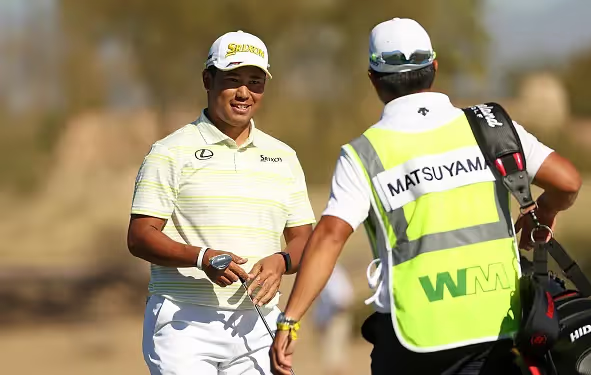

SCOTTSDALE, Ariz. — Hideki Matsuyama stood on the first playoff tee at TPC Scottsdale, needing one good swing to keep his championship hopes alive. For a player who had somehow survived 11 missed fairways in regulation through brilliant scrambling and an otherworldly short game, it seemed almost fitting that his fate would come down to one more test off the tee.
The test, as it turned out, was one he couldn't pass.
After a distraction in the crowd caused him to back off his first attempt, Matsuyama re-addressed his ball and pulled his tee shot left — directly into the water hazard that guards the left side of the 18th fairway. The wayward drive, following a similar miss in regulation that led to a closing bogey, sealed a bitter playoff defeat and denied the two-time champion a third WM Phoenix Open title.
"I wanted to avoid the playoff as much as I could, but I just hit a bad tee shot there in regulation at 18," Matsuyama said through an interpreter, his disappointment palpable despite the measured words.
It was a cruel ending to a tournament that Matsuyama had controlled for much of Sunday afternoon, and a stark reminder that precision off the tee still matters — even when everything else is working.
A Round of Survival
Matsuyama's final round was a study in controlled chaos. The Japanese star missed his first fairway at the opening hole and wouldn't find another until the back nine was well underway. By the time he completed his round, he had found just seven of 18 fairways — a statistic that, in any normal week, would doom a player to a finish outside the top 20.
But this was not a normal week, and Matsuyama is not a normal player.
Despite the wayward driving, Matsuyama somehow made the turn at 2-under for his round, extending his lead to two shots over the chasing pack. His secret? An absolutely elite scrambling display that saw him get up-and-down from seemingly impossible positions time and time again.
At the par-3 7th, his tee shot found a greenside bunker in an awkward position. Most players would have been happy to walk away with bogey. Matsuyama splashed out to three feet and calmly rolled in the par putt.
At the par-4 9th, after missing another fairway, he was left with an awkward angle into the green from the rough. His approach came up short in heavy grass, but once again, a deft chip and a clutch putt saved par.
"I felt like I was in control even though I wasn't hitting fairways," Matsuyama said. "My wedge game was really good today, and that kept me in it."
The Shot of the Tournament
If Matsuyama's round had a signature moment, it came at the par-5 13th hole — and it was a shot that, for a brief moment, made it seem like destiny was on his side.
After missing yet another fairway, Matsuyama faced a daunting second shot from 240 yards with the pin tucked back right on the green. Most players would have laid up, especially given the difficulty of holding the green from such a distance with an awkward lie.
Matsuyama, ever the aggressive player, pulled out a fairway wood and took aim.
The ball started well right of the green, looking for all the world like it was headed for the greenside bunker or worse. But as it reached its apex, the ball began to turn — first slightly, then dramatically — carving a beautiful right-to-left shape that brought it back toward the flag.
The ball landed softly on the green, about 20 feet from the hole, and settled. The gallery erupted, and Matsuyama allowed himself a small smile as he walked toward the green.
"That was probably the best shot I hit all day," Matsuyama admitted. "I needed to be aggressive there, and it worked out."
He would convert the eagle putt, no — a two-putt birdie moved him to 17-under and gave him a two-shot cushion with five holes to play. For a moment, it seemed like Matsuyama was cruising to victory.
The Wheels Begin to Wobble
The first crack in Matsuyama's armor came at the par-3 16th, the most famous hole in tournament golf. With over 20,000 fans crammed into the stadium seating surrounding the 163-yard one-shotter, Matsuyama faced a tee shot that was equal parts golf shot and nerve test.
His 7-iron came up just short of the green, settling in a greenside bunker in a relatively decent lie. But the sand shot came out too firm, rolling 15 feet past the hole and leaving a difficult downhill putt for par.
The par putt never had a chance, sliding by the right edge, and Matsuyama tapped in for bogey. Just like that, his two-shot lead was cut to one, and the pressure was mounting.
"The 16th is always tough," Matsuyama said. "You try to block out the noise, but it's hard. I just didn't execute the bunker shot the way I wanted to."
The Near-Disaster at 17
If the bogey at 16 was concerning, what happened at the par-4 17th was nearly catastrophic.
The 17th hole at TPC Scottsdale is one of the most exciting in professional golf — a short, driveable par-4 where players can reach the green off the tee but face significant danger with water lurking left of the putting surface. It's the kind of hole that can produce eagles, birdies, pars, and disasters all in the same group.
Matsuyama, having struggled with his driver all day, wisely chose to hit 3-wood off the tee, looking to lay back short of the green and leave himself a simple wedge into the pin. The strategy was sound, but the execution was not.
The tee shot started left almost immediately, heading directly toward the water hazard. For a moment, it appeared certain that Matsuyama's ball was going to find the water, which would have likely ended his championship hopes on the spot.
But golf, as they say, is a game of inches. The ball landed on the very edge of the hazard line, no more than two or three feet from the water, and somehow stayed dry. Matsuyama had dodged a bullet — but barely.
"I got lucky there," Matsuyama admitted. "If that ball goes in the water, it's over."
The relief was short-lived, however, as Matsuyama was left with an extremely awkward stance for his second shot. His left foot was nearly in the water, and he had to choke down significantly on the club just to make contact with the ball.
The punch shot advanced the ball only about 40 yards, leaving him with another awkward pitch from thick rough. That shot came up well short of the green, and after a mediocre chip and two putts, Matsuyama walked off with a par — but his lead had evaporated.
Playing partner Michael Thorbjornsen, who had been lurking all day, made birdie at 17 to join Matsuyama at 16-under. Suddenly, what had been a comfortable two-shot lead with five holes to play was gone entirely.
The Decisive Moment
Coming to the 72nd hole, Matsuyama knew the situation: Chris Gotterup had already posted 16-under in the clubhouse, and Thorbjornsen was tied for the lead at 16-under. Matsuyama needed a birdie at the par-5 18th to win outright, or a par to force a playoff.
The par-5 finishing hole at TPC Scottsdale is reachable in two for the tour's longest hitters, but accuracy off the tee is paramount. The hole doglegs slightly left, with bunkers lining both sides of the fairway and water protecting the left side of the green on the approach.
Matsuyama, whose driver had betrayed him all day, faced a critical decision: stick with the driver and risk another wayward tee shot, or play it safe with a 3-wood or long iron.
He chose the driver.
The decision was understandable — a good drive would leave him a mid-iron into the green with a realistic chance at eagle and an almost certain birdie. But Matsuyama's driver, which had been so unreliable all day, chose the worst possible moment to let him down again.
The tee shot pulled left almost immediately, heading toward the infamous church pew bunkers that line the left side of the 18th fairway. The ball found the sand, settling into an awkward lie that would make it nearly impossible to reach the green in regulation.
"I just hit a bad tee shot," Matsuyama said simply. "I needed to hit the fairway there, and I didn't."
From the bunker, Matsuyama faced a shot of about 240 yards to the green, but with the ball sitting down in the sand, he had almost no chance of advancing it that far. He attempted to hit a hard 3-wood, but caught the lip of the bunker on the way out, and the ball traveled only about 100 yards before settling in more rough.
Now facing a third shot from 140 yards, Matsuyama's frustration was evident. He yanked his wedge approach left of the green, leaving himself a difficult up-and-down from 43 yards just to save par and force a playoff.
The chip was tentative, coming up short of the hole and leaving a 12-foot par putt. The putt never had a chance, sliding by the right edge, and Matsuyama tapped in for bogey.
He would finish regulation at 16-under, tied with Gotterup and headed to a playoff. Thorbjornsen, meanwhile, also bogeyed the 18th after finding the water with his second shot, finishing one back at 15-under.
The Playoff: History Repeats
The playoff format was simple: sudden death, starting back at the 18th tee. For Matsuyama, it was a chance at redemption — an opportunity to erase the bogey he had just made and claim the victory that had seemed so certain just an hour earlier.
But it would require the one thing that had eluded him all day: a good drive.
As Matsuyama stood over his ball on the first playoff tee, a commotion in the crowd caused him to back off. He reset, took a deep breath, and addressed the ball again.
The swing looked solid, but the result was heartbreakingly familiar. The ball started left, just as it had in regulation, and this time there would be no miraculous bounce to save it. The ball splashed into the water hazard, and Matsuyama's shoulders slumped.
"I just didn't execute," Matsuyama said. "Same miss as regulation. I needed to hit it straight, and I didn't."
Gotterup, meanwhile, had no such issues. His drive was pure, a massive 360-yard bomb that carried the 340-yard bunker and settled comfortably in the fairway. From there, it was academic — a short iron to the green, two putts for birdie, and the victory was his.
Matsuyama, forced to take a penalty drop, could only watch as his championship hopes disappeared into the desert evening. His fourth shot came up short of the green, and he conceded the hole and the tournament.
A Pattern of Near-Misses
The loss was particularly bitter for Matsuyama because it continued a frustrating pattern of near-misses in recent years. Since winning his first major championship at the 2021 Masters, Matsuyama has been in contention numerous times but has struggled to close the deal.
Sunday's collapse — if it can even be called that, given how well he played with his wedges and putter — felt like yet another missed opportunity to add to his resume.
"It's frustrating because I felt like I did a lot of things well today," Matsuyama said. "I made a lot of great pars when I was in trouble. I hit some really good shots. But in the end, you have to hit fairways, and I didn't."
The statistics tell the story: Matsuyama ranked 67th out of 68 players who made the cut in driving accuracy for the final round, finding just seven of 18 fairways (38.9%). For context, the field average was around 60%.
Yet somehow, through brilliant scrambling, he still managed to shoot 68 and nearly win the tournament. It was a testament to his short game skills, but also a reminder that even the best scrambling in the world can't overcome consistently poor driving at the highest level.
What's Next?
Despite the disappointment, Matsuyama leaves the WM Phoenix Open with plenty of positives. His short game was exceptional all week, ranking near the top of the field in scrambling. His putting was solid, particularly on the back nine Sunday when he needed to make clutch par saves.
And his ball-striking, while wayward off the tee, was actually quite good with his irons and wedges. Several times during the final round, he hit approach shots from difficult positions in the rough that stopped within 15 feet of the hole — shots that lesser players would have been happy just to get on the green.
"I'm proud of how I fought today," Matsuyama said. "It didn't work out in the end, but I gave myself a chance. That's all you can ask for."
The runner-up finish earned Matsuyama $1,044,000 from the $9.6 million purse and 300 FedExCup points, solid numbers that will help him as the season progresses. But for a player of his caliber, the money and points are secondary to the victory that slipped away.
As Matsuyama packed up his clubs and prepared to leave TPC Scottsdale, he was already looking ahead to the next opportunity. The PGA Tour season is long, and there will be plenty more chances to claim that elusive third WM Phoenix Open title.
But on this Sunday evening in the Arizona desert, all he could think about was what might have been if just one or two of those drives had found the fairway.
"I'll learn from this," Matsuyama said. "I always do. And I'll be ready the next time I have a chance to win."
For the two-time champion who came agonizingly close to a third title, that's all he can do: learn, prepare, and wait for the next opportunity. And when that opportunity comes, you can bet he'll be thinking about the two drives that cost him the 2026 WM Phoenix Open — the one in regulation and the one in the playoff that both went left when he needed them to go straight.
Sometimes in golf, as in life, the difference between triumph and heartbreak is measured in inches and angles. On Sunday, those inches went the wrong way for Hideki Matsuyama, and now he's left to wonder what might have been.