























F1 Agrees in Principle to Bring Back V8 Engines in 2030 With a 2.1-Liter Turbo and Less Hybrid Power
The FIA, Formula One Management and F1's engine makers have agreed in principle on a 2030 framework built around a 2.1-liter turbocharged V8 with reduced hybrid power, with final approval set for December.
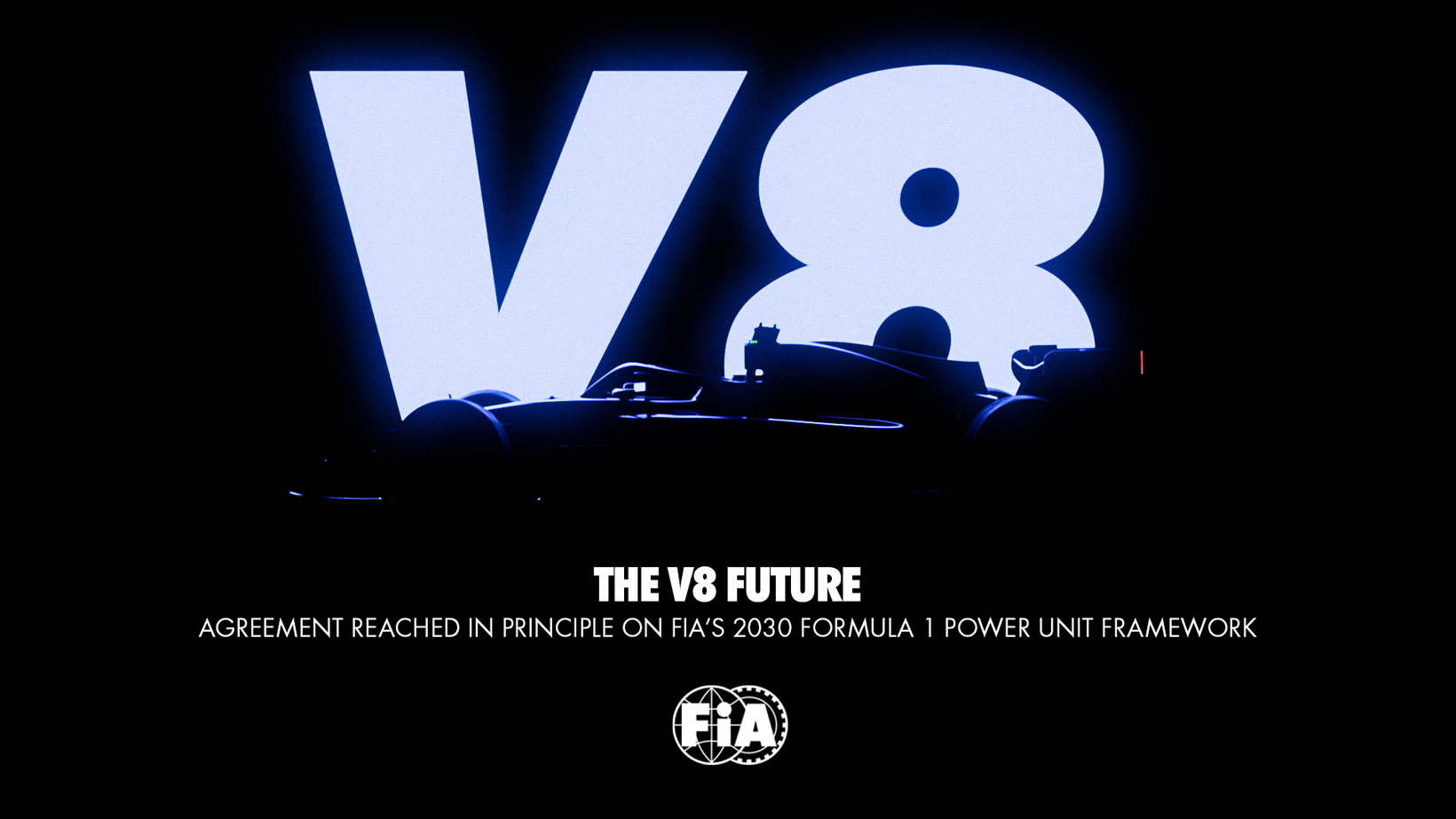
Formula 1 spent 2026 learning to live with the most electrified engines it has ever run. Now the sport has agreed, at least in principle, to swing hard the other way. The FIA announced on Tuesday, Nov. 17, that it, Formula One Management and the power unit manufacturers have reached an agreement in principle on a 2030 framework built around a 2.1-liter turbocharged V8 with reduced hybrid assistance, according to the FIA's announcement as reported by Grande Premio (opens in a new tab).
The deal came out of a meeting at the FIA's headquarters in London, and it is not a finished rulebook. The governing body plans to present a definitive 2030 regulatory framework to the FIA World Motor Sport Council when it meets in Shanghai in December, and every change still needs that council's approval before it is locked in.
What the FIA actually agreed to
The headline is the engine: eight cylinders, 2.1 liters, a turbocharger, and a hybrid system that does a lot less of the heavy lifting than the current units. The FIA was blunt about the goal. "The overriding objective is to deliver a power unit which is a lot less complex, lighter and cheaper than the current power units," the governing body said. It also wants the new engines to use relevant sustainable technology and to produce a sound that appeals to fans, which is a polite way of admitting the current soundtrack has not won many hearts.
The engine is only half the package. The plan pairs it with lighter, more agile cars that put more weight on driver skill, overtaking and close racing. The V8 will keep turbocharging and some of the current geometric specifics, Motorsportive reported (opens in a new tab), while shedding much of the mechanical complexity.
There is a timing twist, too. Members of the F1 Commission, which includes the current teams, backed ending the current power unit cycle after 2029, one year earlier than the 2031 date that had been floated, GPOne reported (opens in a new tab). That support hinges on the manufacturers signing off on the proposed changes.
Ben Sulayem gets his V8
FIA president Mohammed Ben Sulayem has pushed for a V8 return for months, and he framed Tuesday as a win for the sport's identity. "This agreement in principle marks a significant milestone in shaping the future of Formula 1," he said. "From the outset I have been clear in my ambition to deliver a sport that is more competitive and more exciting for our fans, while remaining at the forefront of innovation and sustainability."
He went further on the sound and feel. "The return of V8 engines represents an opportunity to reconnect with the DNA of this Championship, bringing back the sound, emotion and pure racing that is loved worldwide," Ben Sulayem said. "Our vision is clear, lighter, simpler and more affordable cars that put driver skill at the heart of the competition."
Not your 2013 V8
Anyone picturing the shriek of the old naturally aspirated engines should adjust expectations. The V8s that F1 last raced in 2013 were 2.4-liter units with no turbo. The 2030 version keeps forced induction and a smaller hybrid component, so it will sound different from both that era and today's 1.6-liter V6 hybrids, which arrived in 2014 and took on an even bigger electrical share under the 2026 rules.
The displacement also moved. Earlier talks between the FIA and manufacturers had centered on a 3.0-liter turbo V8 with roughly 100kW of electrical assistance, according to Grande Premio, before the governing body settled on 2.1 liters as its preferred architecture.
The fine print still matters
An agreement in principle settles the shape of the engine and the target date. It does not settle the numbers that decide who wins. Still to be written are the permitted electrical output, energy storage rules, the minimum weight, fuel specifications and development restrictions.
Manufacturers want those answers quickly. Audi chief technical officer Mattia Binotto had previously called for the regulations to be agreed before the end of 2026 so engine makers could start detailed concept work in 2027, Grande Premio noted. A December vote in Shanghai would just about hit that window.
The rule change also lands on a grid that has spent this season fighting over engine performance under the current formula. The FIA's final 2026 ADUO review granted no new engine upgrades, and Mercedes has already wrapped up both titles, with Kimi Antonelli crowned the youngest champion in F1 history. Whoever reads the 2030 rules best gets a clean shot at resetting that order.
What comes next
For now, the 2026 season rolls on with its current engines, starting with this weekend's Las Vegas Grand Prix, where Haas keeps Rafael Câmara in the car. The bigger date to circle is the World Motor Sport Council meeting in Shanghai next month. If the manufacturers sign on and the council approves the framework, the V6 hybrid era would end after the 2029 season, and the sport's next engine would sound a lot more like the one fans keep asking for.
Sources: FIA, Grande Premio, Motorsportive, GPOne, RacingNews365.
Related Coverage
FIA's Final 2026 ADUO Review Grants No New F1 Engine Upgrades: What Each Manufacturer Keeps
November 11, 2026
F1 Standings: Antonelli and Mercedes Are Champions, but the Fight for Second Is Wide Open
November 11, 2026
Lando Norris Wins Wet Sao Paulo Grand Prix as Mercedes Clinch Constructors' Title
November 8, 2026

More From Kiley McFadden
View All stories by Kiley McFadden
Fernando Alonso Will Race the 2027 Dakar Rally for Aston Martin Before His F1 Season Begins
November 17, 2026

Florida Holds No. 1 as No. 2 Michigan State Climbs and Kentucky Drops Out of the Men's AP Top 25
November 17, 2026

Omarion Hampton Runs for 105 and Justin Herbert Scores as the Chargers Grind Out Their First Win in Baltimore
November 17, 2026