












Why Today's Black Friday NFL Game Kicks Off at 3 PM: A 65-Year-Old Law
Today's Broncos-Steelers Black Friday game kicks off at 3 p.m. ET because of a 65-year-old law, the Sports Broadcasting Act of 1961, which keeps the NFL out of Friday primetime to protect high school and college football.
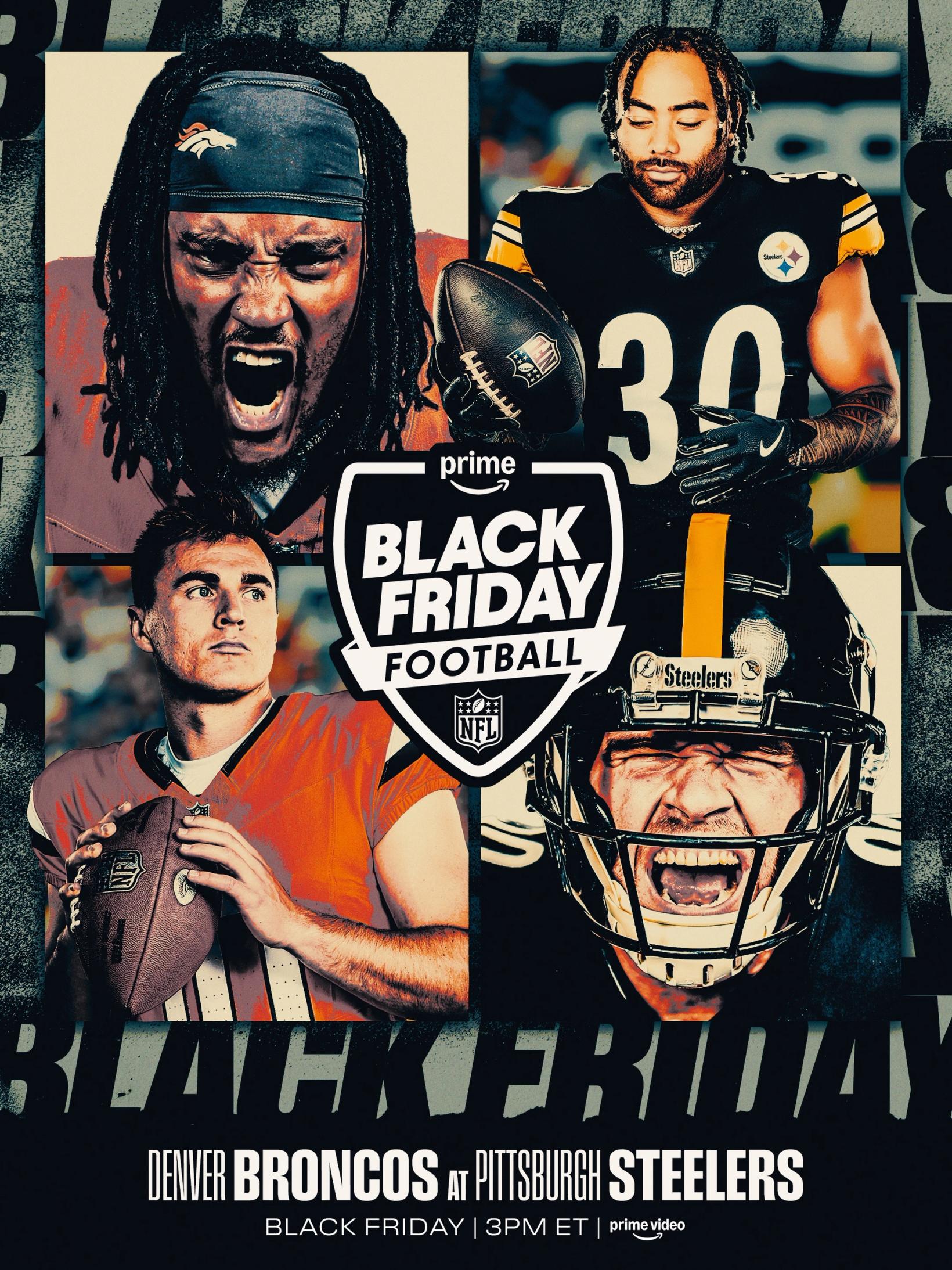
Today, the Denver Broncos visit the Pittsburgh Steelers at Acrisure Stadium, and the game kicks off at 3 p.m. ET on Amazon Prime Video. It is the NFL's fourth annual Black Friday game, and the start time is the strangest thing about it. The NFL does not play afternoon games on Fridays. It does not put its product on at 3 p.m. on the biggest shopping day of the year by accident.
The 3 p.m. kickoff exists because of a 65-year-old federal law: the Sports Broadcasting Act of 1961.
Before the law, every team sold its own TV rights
Before 1961, NFL teams sold their television rights individually. That worked fine for big-market teams, which could command real money for their games, and badly for small-market teams, which could not. The gap threatened the league's competitive balance, so the NFL did something radical for its time: it pooled every team's TV rights together and sold them as a single package to CBS, then split the money equally.
A federal judge blocked it. Judge Allan K. Grim ruled that the pooled deal violated the Sherman Antitrust Act, and the league's new television model was dead on arrival.
So the NFL lobbied Congress. The argument was that pooling media rights and splitting the revenue equally was in the best interest of the league's long-term financial viability, and that without it, the small-market teams that made the league a league would wither. Congress agreed, and President John F. Kennedy signed the Sports Broadcasting Act into law on September 30, 1961. The law, codified at 15 U.S.C. sections 1291 through 1295, gave professional sports leagues an antitrust exemption to pool their broadcast rights and sell league-wide television deals.
The caveat that still runs the schedule
Congress did not hand the NFL a blank check. To protect high school and college football, lawmakers added a clause that has shaped the NFL's schedule ever since.
The exemption does not cover the telecasting of "all or a substantial part" of a professional football game on any Friday after 6 p.m. or on any Saturday, from the second Friday in September through the second Saturday in December, from any television station located within 75 miles of the site of a high school or college football game scheduled for that day. In 2026, that window runs from Friday, September 11, through Saturday, December 12.
The rule is narrower than it sounds, and more powerful than it looks. It does not ban the NFL from playing games on those days. It withdraws the antitrust exemption for the telecast. And because virtually every NFL team plays within 75 miles of a high school football team, the restriction effectively covers the entire country. The NFL earns more than 60 percent of its revenue from selling broadcast rights, and a single breach could put the exemption itself at risk, so the league has treated Friday nights and Saturdays in the fall as off-limits for 65 years.
The 3 p.m. workaround
With Commissioner Roger Goodell chasing the goal he set in 2010, $25 billion in annual revenue by 2027, the league has kept hunting for new windows to sell. The NFL was at roughly $8 billion when Goodell set the target. It has passed $23 billion, and Black Friday is one more tentpole.
Related Stories
- NFLAaron Rodgers Rips Mike McCarthy on The Pat McAfee Show, Says 'That Ship Has Sailed' in Pittsburgh3 min read
- NFLAaron Rodgers Excused From Steelers Facility After Tuesday Benching, According to ESPN4 min read
- NFLBroncos Suspend J.K. Dobbins One Game for Conduct Detrimental to the Team Ahead of Black Friday at Pittsburgh4 min read
The NFL sold the Black Friday game to Amazon, which reportedly paid $100 million for the rights to the first one, the Dolphins-Jets game in 2023, on top of the roughly $1 billion a year it already pays for Thursday Night Football. The league felt comfortable doing it for two reasons.
First, the Sports Broadcasting Act covers sponsored telecasting, meaning broadcast television. Streaming lives outside the statute's reach, or at least the NFL has treated it that way, and the law's authority has only faded further as leagues have signed more deals with cable and streaming outlets that were never the free over-the-air broadcasts the Act was written for.
Second, the statute says "all or a substantial part." A game that kicks off at 3 p.m. ET is mostly over before 6 p.m. The average NFL game lasts three hours and 12 minutes, so today's game should end a little after 6 p.m. Only a small portion leaks past the deadline.
That second argument is not airtight. Legal analysts have noted that the fourth quarter, arguably the most exciting part of the game, does run past 6 p.m., which means a "substantial part" of the contest could be said to air inside the restricted window. The NFL seems unconcerned about the prospect of being sued over it, which says as much about the law's fading authority as it does about the league's appetite for the revenue.
Why Amazon loves it
For Amazon, the game is a home run. The audience has grown every year: the inaugural Black Friday game in 2023 averaged 9.61 million viewers, the 2024 game drew 13.51 million, and last year's Bears-Eagles game averaged 16.33 million, the most-watched Black Friday sporting event since at least 1991, peaking at 20.08 million viewers. That is 10 to 16 million people staying home to watch football on the year's biggest retail shopping day, with the National Retail Federation expecting 130 million Americans to shop on Black Friday alone.
And Amazon does not just show them ads. It shows them audience-specific ads based on their shopping history, through a strategy called audience-based creative, and viewers can add items from a commercial to their cart with a single push of a button and check out without ever leaving the game. Amazon reportedly charges $800,000 for a 30-second commercial in the game. The football is the programming. The shopping is the point.
Today's game
The football is real, too. The Broncos arrive in Pittsburgh riding one of the NFL's longest winning streaks, with Bo Nix at quarterback. The Steelers are turning to Mason Rudolph after releasing Aaron Rodgers. Both teams are firmly in the AFC playoff hunt, and the game matters beyond the novelty of the window.
Kickoff is at 3 p.m. ET at Acrisure Stadium, streaming nationally on Amazon Prime Video, free to watch even without a Prime membership, with local simulcasts on WTAE-TV in Pittsburgh and Denver7 in Denver. Pregame coverage begins at 1:30 p.m. ET, with Al Michaels on play-by-play, Kirk Herbstreit as analyst and Kaylee Hartung on the sideline.
It is a Friday afternoon NFL game in late November, in primetime's shadow, because a law written to protect Friday night high school football in 1961 still says the NFL cannot have the evening. The league found the gap in the statute, Amazon found the shoppers, and 3 p.m. is the price of both.
Sources: Sports Broadcasting Act of 1961 (15 U.S.C. sections 1291-1295); McLane Middleton; Legal 500; Nova Sports Law; Front Office Sports; USA TODAY; Sports Business Journal; Sports Media Watch; NewsNation.

Austyn McFadden
Co-Founder
I co-founded Undrafted, helping grow it from two people with cameras into a credentialed sports media organization covering thousands of college and professional events each year. My background spans sports media, brand strategy, identity, and digital design. I have also spoken on photography, branding, and entrepreneurship at Nossi College of Art, Greenon Local Schools, and Wright State University through Reynolds & Reynolds.
View profile and all storiesMore From Austyn McFadden
View All stories by Austyn McFadden
Shelton Henderson Posts 25 and 10 as No. 17 Miami Routs Michigan 97-70 in Las Vegas
Dai Dai Ames Scores 19 as No. 9 Tennessee Leads Wire to Wire, Beats Iowa State 75-64 in Las Vegas