
















Emails Show the SEC Ran a Media Campaign Against LSU
The league worked with crisis firm Legend Labs on interviews, an op-ed and social media tracking during the eligibility fight, and the two players at the center of it, Dae’Quan Wright and Zxavian Harris, now have nowhere to play.
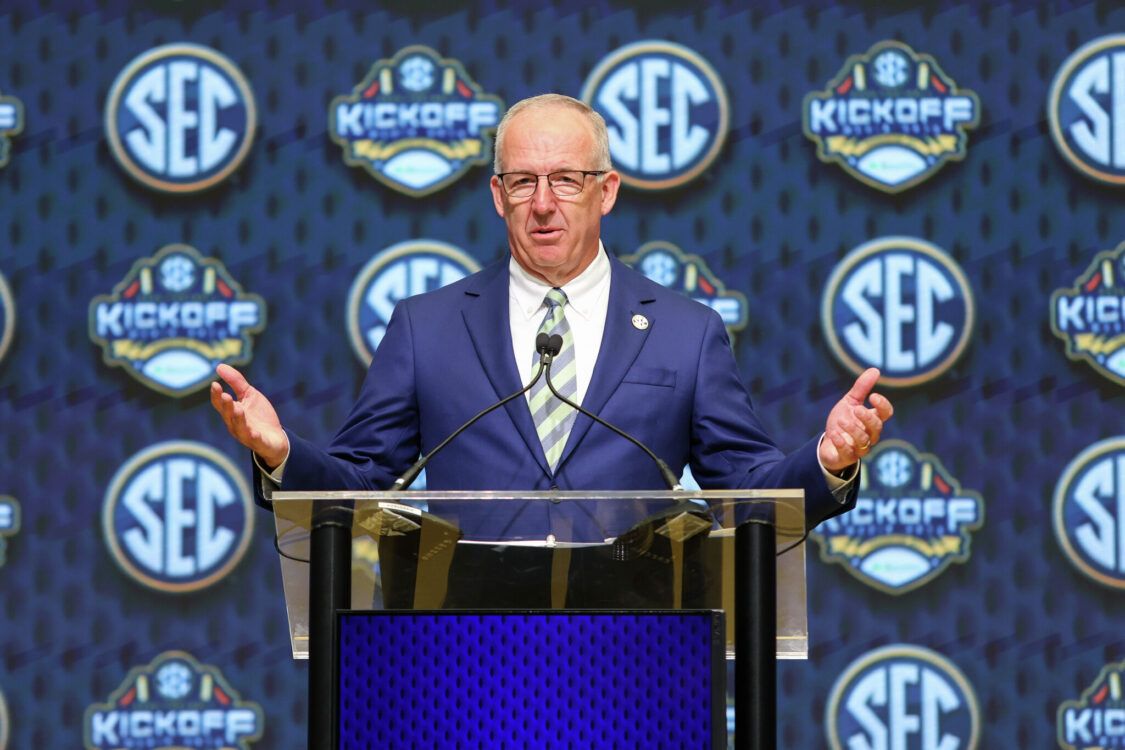
The SEC did not just take LSU to court. Emails obtained by Front Office Sports show the conference also hired a crisis communications firm to shape how the country saw the fight, and the two players at the center of it now have nowhere to play.
The records, released this week, show a league fighting on two fronts at once. In the courtroom, the SEC sued LSU over its attempts to roster former professional athletes. In public, the league worked with Legend Labs, a crisis communications firm, on a coordinated campaign that included interviews with national outlets, an op-ed placed in USA Today, and close tracking of social media reaction. LSU was the only SEC school left out of the emails.
The story the league wanted told was simple: the SEC was defending the line between college and professional sports. The story the emails tell is more complicated, and it ends with two players who tried to come back to college football unable to play anywhere at all.
The guide nobody at LSU saw
On Monday, August 31, University of Missouri president Mun Choi forwarded a strategy guide from Legend Labs to SEC commissioner Greg Sankey and leaders at every SEC school except LSU. The guide arrived days before the conference sued the Tigers.
The guide summarized coverage of the developing dispute and set themes for future SEC communications. It contrasted the "potential risk of LSU's approach" with "questions around the SEC's authority," and it stressed that complying with court orders "does not prevent the SEC from continuing to defend its rules."
It also pointed to eligibility challenges at Purdue and Houston as evidence the fight extended beyond the SEC, and it noted the controversy was entering the broader debate over the Protect College Sports Act, the federal bill that would give college sports a national eligibility framework.
Choi's accompanying message said Legend Labs would brief the SEC presidents and chancellors on its communications strategy at their meeting the next day, September 1.
The rollout
The campaign moved fast. On September 1, Tennessee chancellor Donde Plowman sent a follow-up email to the same group with the note, "Further update on today's activities." It included a link to an interview she and University of Georgia president Jere Morehead had given to ESPN about the dispute.
Related Stories
- College FootballDJ Jacobs Decommits From Ohio State and Flips to Miami Days Before the Early Signing Period3 min read
- College FootballCFP Rankings: Georgia Stays No. 1 as Texas, Notre Dame and Tennessee Climb Into the Top 5 and UCLA Falls to No. 93 min read
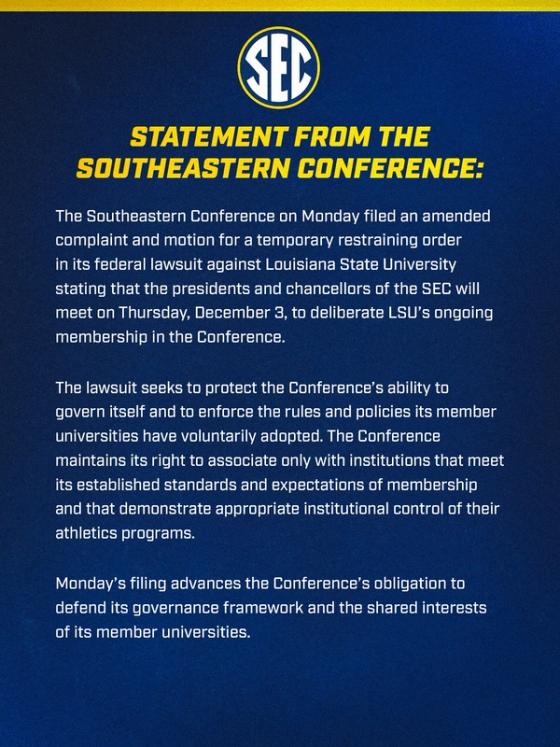
- College FootballSEC Presidents Will Meet December 3 to Deliberate LSU's Membership4 min read
Plowman told ESPN the conference would defend its rules and backed significant penalties for violations, putting pressure on LSU while projecting unity among SEC leaders. "This is not a rule we will budge on," Plowman told ESPN. "Enough is enough."
The same email carried a draft of Choi's op-ed, which would be placed "in a national outlet." USA Today published it the next day under the headline "The line in the SEC between college professional sports still matters."
The draft the presidents passed around differed from the version the public read. In the draft, Choi described the athletes as a "handful of individuals who are trying to change the rules" who would respond to "the incentives they are offered." The published version replaced that passage with language about "young people who have worked incredibly hard to pursue opportunities in sports."
Both versions made the same argument: the competitive interests of one coach or one university should not outweigh the standards of the conference and college sports, and conflicting court orders were a reason for Congress to pass the Protect College Sports Act. Choi wrote that an athlete who has signed a professional playing contract "has entered professional sports and should not be permitted to return to college competition in that sport," and that college programs "should not become fallback options when a professional opportunity ends."
The firm behind it
Legend Labs is a strategic communications firm based in Austin, Texas, that describes its work as branding, storytelling, reputation management and crisis counsel. Its founding partner is Jeff Hunt, a 35-year communications veteran who previously served as president of Cohn & Wolfe and chief executive of GCI, and spent 18 years at Burson-Marsteller, ultimately as chief operating officer for Europe. The firm publicly lists the SEC and conference members Tennessee, Florida and Texas among its clients, alongside companies such as Caterpillar and Johns Hopkins University and The Recording Academy. In October 2025, it hired Pardis Mahdavi to lead a higher education practice.
The SEC is not new to paying for influence in Washington and in public. A 2024 Front Office Sports investigation found the NCAA and the Power 5 conferences spent more than $15 million combined on lobbying firms since 2019, plus an undisclosed amount on public relations firms. The SEC has used the lobbying firm Akin Gump since 2020.
What the new emails show is the machinery working in real time, during a live dispute, with the league's own presidents as the messengers.
The tracking
Legend Labs did not just write the message. The firm tracked individual social media posts, listing engagement and view counts alongside its assessment of the coverage.
Its selections included a post by attorney Tom Mars about the legal arguments behind the eligibility lawsuits, which it logged at 321,200 views and 1,200 engagements. The report's assessment said legal voices were expressing confidence in the SEC's position.
The monitoring extended to LSU soccer. The report included a post by radio host Matt Moscona noting that Jazmin Ferguson and Jocelyn Ollivierre, both plaintiffs in the eligibility case, had entered LSU's match against Arizona. It listed 177,600 views and 778 engagements.
A crisis firm hired by the conference was watching substitutions in a women's soccer match. That is how closely the league was measuring the public reaction to its fight with one of its own members.
What the fight was about
The dispute began with a lawsuit, Pyburn v. NCAA, brought by 43 former college athletes who graduated high school in 2022. In June, the NCAA adopted a new rule giving athletes up to five years of eligibility, but the class of 2022 was excluded from the change. The players argued the exclusion was unfair, pointing to the blanket eligibility waiver the NCAA issued during the COVID-19 pandemic in 2020.
The lead plaintiff was Jack Pyburn, a former LSU edge rusher who played at Florida before transferring to LSU in 2025 and was then signed by the Tampa Bay Buccaneers. The players were represented by Baton Rouge attorney Tony Clayton, and the case was heard by Judge William Jorden of the 19th Judicial District Court in Baton Rouge.
In August, a Louisiana judge issued a temporary restraining order on behalf of 33 athletes from the class of 2022, granting them a fifth year of eligibility. A Dallas judge issued a similar order for 41 named players, and the Baton Rouge court followed with an amended order that explicitly named the SEC and Sankey.
On September 3, after a hearing of roughly nine hours that included more than three hours of testimony from Sankey, Jorden converted the temporary restraining order into a preliminary injunction barring the NCAA and the SEC from punishing schools that played the named plaintiffs. The same day, the SEC filed its own federal lawsuit against LSU in Birmingham, in the U.S. District Court for the Northern District of Alabama, naming head coach Lane Kiffin, athletics director Verge Ausberry and president Wade Rousse as defendants. The suit rests on a First Amendment freedom-of-association argument: that the conference has the right to set rules governing competition among its members, and that a commitment to those rules is a condition of membership.
On September 8, the conference scheduled a meeting for September 10 to consider expelling LSU. LSU and Kiffin backed down later that day, filling the football roster without the two contested players. Before its Week 2 game against Louisiana Tech, LSU filled its final two roster spots with other players, closing the door on the pair for the season.
A Louisiana appeals court later reaffirmed Jorden's injunction, denying the SEC's request to suspend it. Ryan Downtown, the attorney representing Wright and Harris, said the court confirmed the trial judge's finding that the NCAA's refusal to grant the class of 2022 a fifth year "likely violated the NCAA's own bylaws."
The two players left behind
The campaign centered on tight end Dae'Quan Wright and defensive tackle Zxavian Harris. Both played for Kiffin at Ole Miss in 2025, went undrafted in the spring, spent time on NFL rosters, Wright with the Philadelphia Eagles and then the Cleveland Browns, Harris with the New Orleans Saints, and were cut. When the court order opened a path back to college, both committed to LSU.
Neither ever played a down for the Tigers. Wright had practiced twice with the team and told reporters the night of the hearing that he expected to play in the season opener against Clemson. Instead, he watched. Harris had not practiced because of a foot injury.
Then the door closed from the other side. On September 16, the NFL sent a memo to all 32 teams declaring Wright and Harris ineligible to visit, try out with or be signed by NFL clubs during the 2026 season, because they were eligible for the 2026 draft and returned to college after training camp opened. The Green Bay Packers had worked out Harris before the memo and will not face discipline. The NFL Players Association is investigating, and the possibility of a grievance remains on the table.
The UFL has confirmed both players are eligible to play in that league. Otherwise, neither will play football at all in 2026. Both become free agents in the 2027 offseason. Wright's agent, Drew Rosenhaus, said his client is "looking at his legal options right now."
Pyburn, the lead plaintiff, will not return to college either. After being waived by Tampa Bay, he was claimed off waivers by the Kansas City Chiefs.
Nearly 400 athletes have now sued the NCAA over the eligibility rule at the center of the case. The two at the center of the SEC's media campaign are the ones with nowhere to play.
Where it stands now
The dispute has since moved to men's basketball. LSU added former St. John's guard RJ Luis Jr., who played in Boston Celtics preseason games, after he obtained a court order blocking SEC penalties. He played 15 minutes against Louisiana-Monroe on November 18, scoring 11 points with nine rebounds in a 79-67 win. The next day, Rousse instructed coach Will Wade not to play him again.
On November 23, the SEC amended its lawsuit, added Wade as a defendant and accused LSU of misleading the conference about its plans to play Luis. The league's filing said, "The SEC simply cannot be certain that Defendants won't change their minds and violate longstanding Conference rules again." The next day, LSU asked a federal judge to dismiss the suit, arguing it was not forcing the SEC to associate with the school and that any harm to the conference was "self-inflicted." Luis has added Sankey as a defendant in his own Baton Rouge suit, and his attorney, Tony Clayton, said the commissioner "will feel the wrath of RJ Luis if not by Christmas, then by New Year's night."
On Wednesday, November 25, U.S. District Judge Annemarie Carney Axon denied the SEC's request for a temporary restraining order that would have barred LSU from interfering with the December 3 vote, rejecting all four of the injunctions the league sought. She said she "can't prevent people from filing lawsuits." She did grant the SEC's motion to supplement its complaint with the Luis allegations. The SEC said in a statement that it "respects the decision" and will proceed with the meeting "based upon LSU's representations that there will be no interference," a statement that never mentioned the denial itself.
LSU said in a filing that it stands to lose as much as $85.4 million in 2027-28 alone if it is expelled. A ruling on the school's motion to dismiss the lawsuit is expected in about two weeks.
On Thursday, December 3, the SEC presidents will meet to consider LSU's membership. Expulsion requires a two-thirds vote, though outlets disagree on the threshold, with some putting it at 10 of the other 15 presidents and others at 11 of 16. LSU is a charter member of the conference, in the league since its founding in 1932.
LSU declined comment for the Front Office Sports report. The SEC did not respond to a request for comment.
Sources: Front Office Sports, USA Today, ESPN, Sports Illustrated, WBRZ, NOLA.com, Pro Football Rumors, The Tuscaloosa News.

Austyn McFadden
Co-Founder
I co-founded Undrafted, helping grow it from two people with cameras into a credentialed sports media organization covering thousands of college and professional events each year. My background spans sports media, brand strategy, identity, and digital design. I have also spoken on photography, branding, and entrepreneurship at Nossi College of Art, Greenon Local Schools, and Wright State University through Reynolds & Reynolds.
View profile and all stories