Ted Hurst III Is Forcing His Way Into the Buccaneers’ Training Camp Conversation
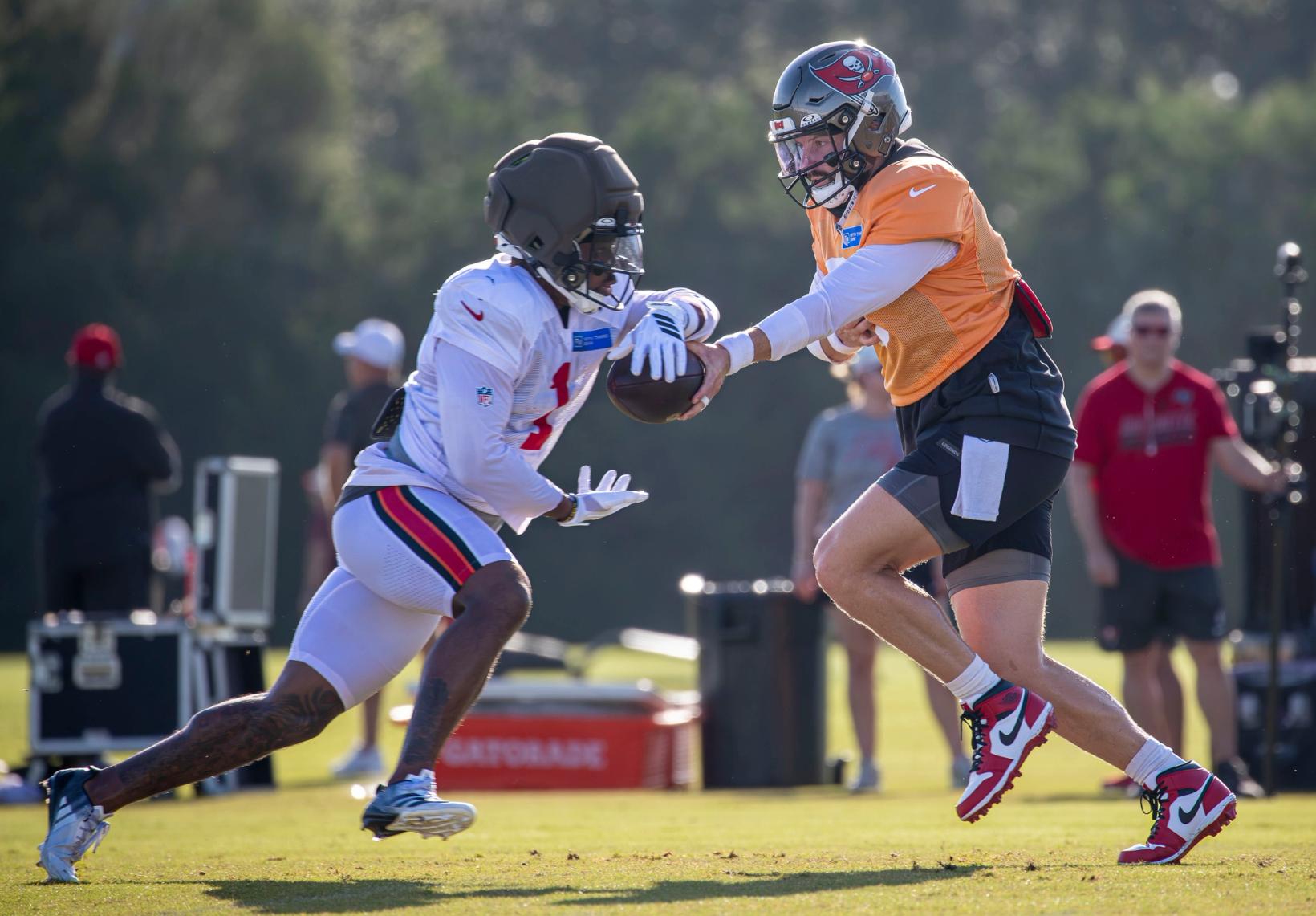
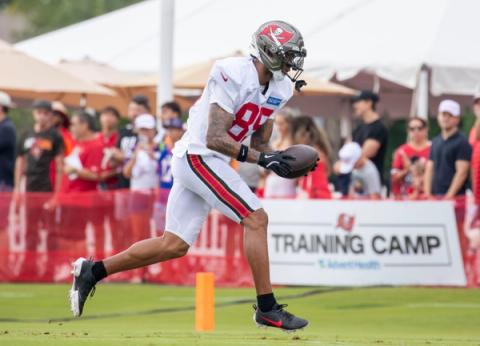
Ted Hurst III hit the ground hard enough to briefly drain some of the energy out of the Advent Health Training Center.
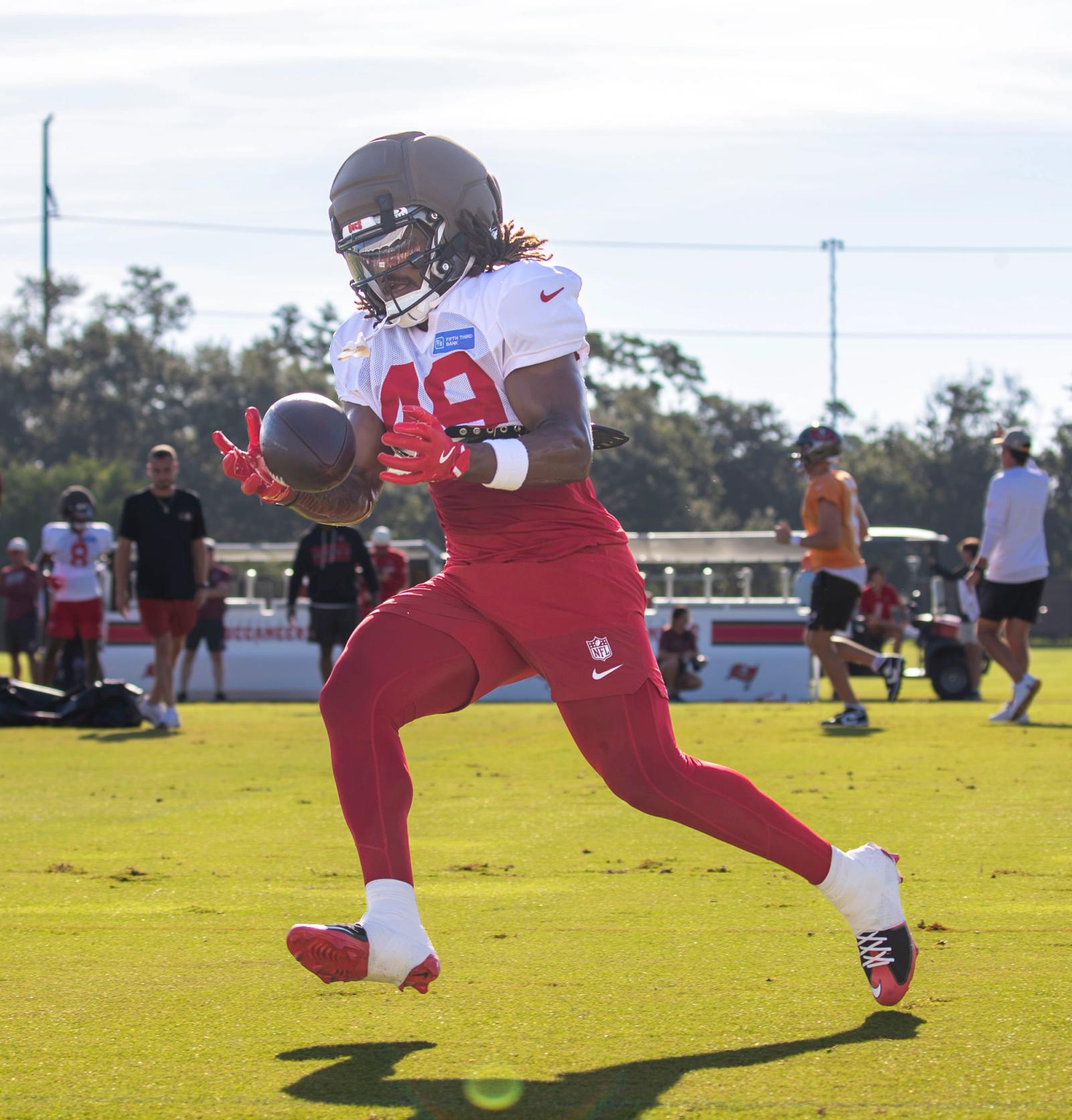
A few seconds earlier, the Tampa Bay Buccaneers rookie wide receiver had gone airborne over Josh Hayes for one of the best catches of practice, extending for an overthrown ball on a deep out while working with the first-team offense. Hurst landed flat on his back, had the wind knocked out of him and needed attention from the training staff.
Then he got up.
Later, during red-zone work, Hurst was back in the middle of everything. This time he worked against Jacob Parrish, won on a fade and finished the rep with a touchdown.
One spectacular catch can be filed inside the enormous folder labeled “training camp things we will forget by September.” Two significant catches with the first-team offense, on different routes and in different situations, from a rookie suddenly receiving an increased workload? That deserves a little more attention.
Not a coronation. Not a declaration that Tampa Bay has unearthed its next star receiver. Just attention.
That distinction matters in August.
Hurst, Tampa Bay’s third-round pick out of Georgia State, is beginning to take advantage of exactly the kind of opportunity training camp is designed to create. Injuries to Jalen McMillan and Tez Johnson have opened repetitions within the receiver rotation, and Hurst is doing more than simply occupying the vacant space.
He is giving the Buccaneers something to consider.
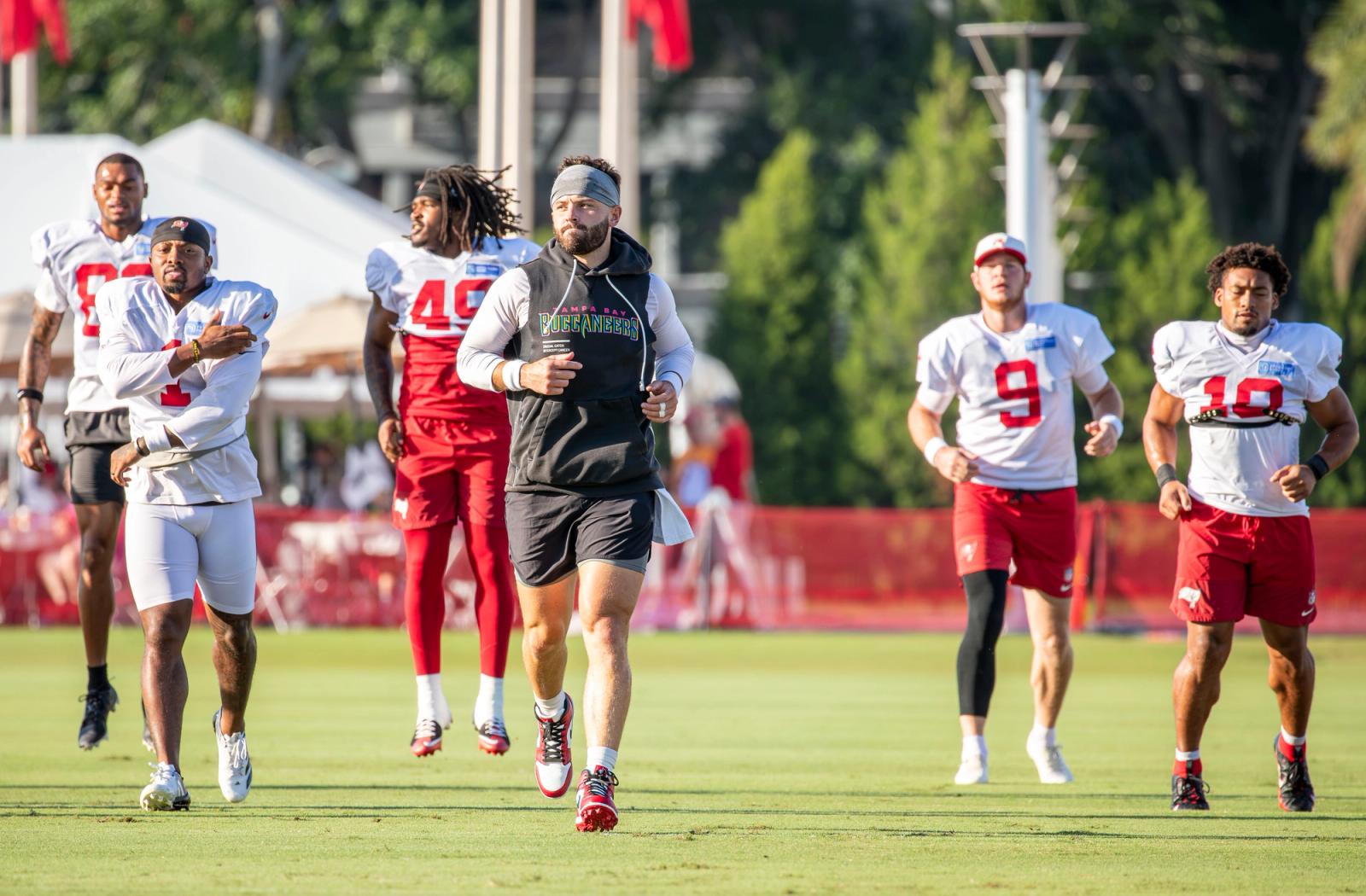
Injuries have a strange way of reorganizing training camp.
Nobody wants them, and the Buccaneers certainly would prefer to have McMillan healthy instead of dealing with a knee injury and Johnson practicing instead of managing a groin issue. But every absence changes the distribution of reps. Suddenly a player who may have been working primarily with another unit finds himself standing next to Baker Mayfield.
For Hurst, those first-team opportunities are becoming increasingly meaningful.
His first big reception came from a trips formation alongside Emeka Egbuka and Chris Godwin. That context matters as much as the catch itself. Tampa Bay was not hiding the rookie in some isolated developmental period against the bottom of the roster. He was functioning within a grouping that included established offensive pieces.
Then came the red-zone touchdown.
Hurst’s explanation afterward was perhaps more encouraging than either catch.
He pointed to preparation, specifically arriving early enough to get additional walkthrough work before practice, as the reason he has felt more comfortable playing quickly instead of processing everything in real time.
“[I’m] just trying to be myself and exploit and show that that’s my game, going up, attacking the ball,” Hurst said. “Lately, I feel like I haven’t been doing that much, but it kind of starts in the morning. Getting up and coming in at 6:30 a.m., getting the walk-through in before we even get outside so I can just play [as] fast as I want to, not thinking out there on the field.”
There is probably no greater training camp cliché than saying the game is “slowing down” for a young player, so we will avoid committing that particular crime.
What Hurst is describing is more specific anyway.
He is reducing hesitation.
That’s important for a rookie receiver because the physical ability that got him drafted does not disappear when he enters the NFL. The difficult part is accessing it while simultaneously processing alignments, coverages, route adjustments, quarterback expectations and the dozen smaller details NFL offenses require on every snap.
Hurst’s best attribute does Tampa Bay little good if he is half a beat late because he is mentally checking his work.
The Buccaneers are now getting glimpses of what happens when he isn’t.
Hurst produced the day’s most exciting moments, but the more important development for Tampa Bay’s offense might be considerably less dramatic.
Chris Godwin looks healthy.
That does not generate the same social-media reaction as a rookie climbing the ladder for a contested catch, but for an offense trying to understand what it can become this season, Godwin’s availability changes the math.
He caught several passes from Mayfield during practice, including a red-zone touchdown, and has been moving around the formation rather than being confined to one role.
More importantly, Todd Bowles sounds encouraged by what he is seeing physically and mentally.
“I think he is healthy right now,” Bowles said. “In the past he has been hurt the last two but he is a lot healthier right now and he is into it mentally he is sharp and he is tough, he understands that he is a great mentor to the guys. He is still a playmaker for us, and he makes big plays in the passing and blocking game. He is peaking at the right time.”
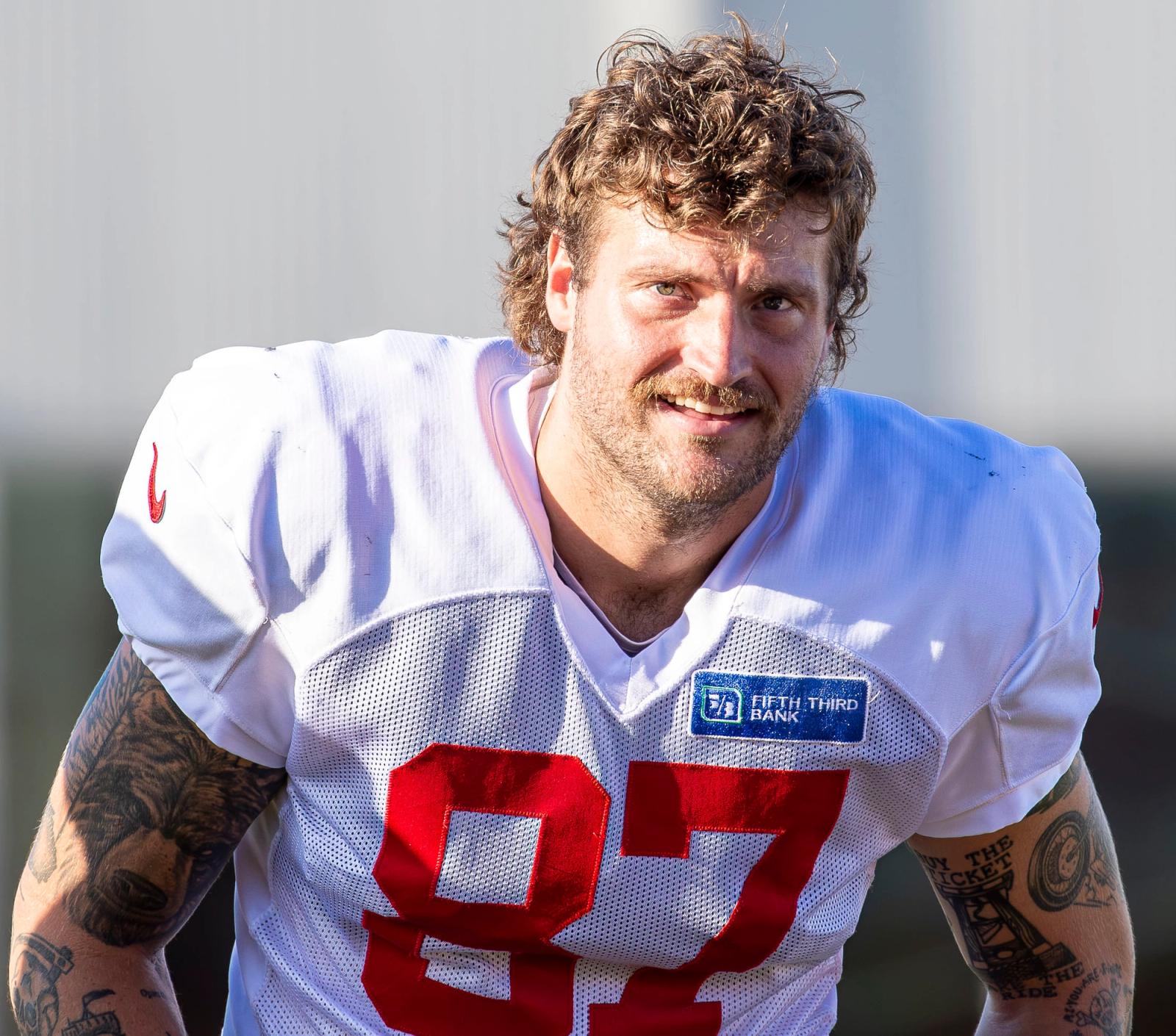
Godwin’s value has never been limited to a highlight reel. His ability to function from different alignments, work through traffic and contribute as a blocker gives Tampa Bay flexibility that becomes especially useful when injuries begin rearranging the rest of the receiver room.
And right now, that room is being rearranged.
McMillan is out. Johnson is out. Hurst is ascending into more prominent reps. Dennis Houston is making his own push.
Houston made another case for himself during red-zone work, catching a Jake Browning touchdown across the back of the end zone.
The coaching staff has been particularly intrigued by Houston’s speed and believes he could be among the fastest players on the roster.
Speed alone does not win roster spots.
NFL camps are full of players who can run extremely fast in straight lines. The real question is whether that speed becomes useful inside an offense and, for players fighting deeper on the depth chart, whether they can provide enough value elsewhere to justify occupying one of 53 spots.
Houston’s touchdown was another piece of evidence.
That is what the back half of a roster battle often becomes. Not one spectacular day, but an accumulation of useful plays that eventually forces coaches to have a longer conversation when cutdown decisions arrive.
With Godwin providing stability and Hurst and Houston capitalizing on opportunities, Tampa Bay’s injury-thinned receiver room has unexpectedly become one of the more interesting areas of camp.
If Hurst is building momentum on offense, David Walker is developing one of the more interesting stories on Tampa Bay’s defense.
Nine consecutive practices.
That is how long the second-year outside linebacker has consistently created problems in the backfield.
Walker missed his entire previous season because of a torn ACL, making his emergence especially notable. Returning from a significant knee injury is one thing. Immediately establishing yourself as a disruptive practice player is another.
During the latest session, Walker came off the left side and would have recorded a sack of Mayfield under live-game conditions. He has been receiving work with both the first and second-team defenses, an important detail for a player trying to move from developmental curiosity to legitimate part of the rotation.
There is an obvious qualifier.
Walker was working against backup tackle Ben Chukwuma rather than Tristan Wirfs, who remains unavailable because of a hamstring injury.
That context cannot be ignored.
Beating a backup offensive lineman in August is not evidence that Walker is suddenly going to terrorize elite NFL tackles once the season begins. If Wirfs were taking those snaps, the difficulty level would change rather dramatically.
But this is where camp evaluation requires restraint in both directions.
You should not overreact to the matchup.
You also should not dismiss nine straight days of disruption.
At some point, repeatedly beating the person assigned to block you becomes exactly what a defensive player is supposed to do.
Walker cannot control which tackle lines up across from him. His responsibility is to win the rep, and lately he keeps doing it.
YaYa Diaby also recorded a would-be sack, giving Tampa Bay another productive moment from an edge group that will eventually be evaluated on something more substantial than untouched quarterback jerseys and coaching whistles.
For now, Walker’s consistency is enough to make him one of the camp’s legitimate players to monitor.
Safety Tykee Smith provided another defensive highlight when he stopped Bucky Irving for no gain during red-zone work.
The reaction from the defense said plenty.
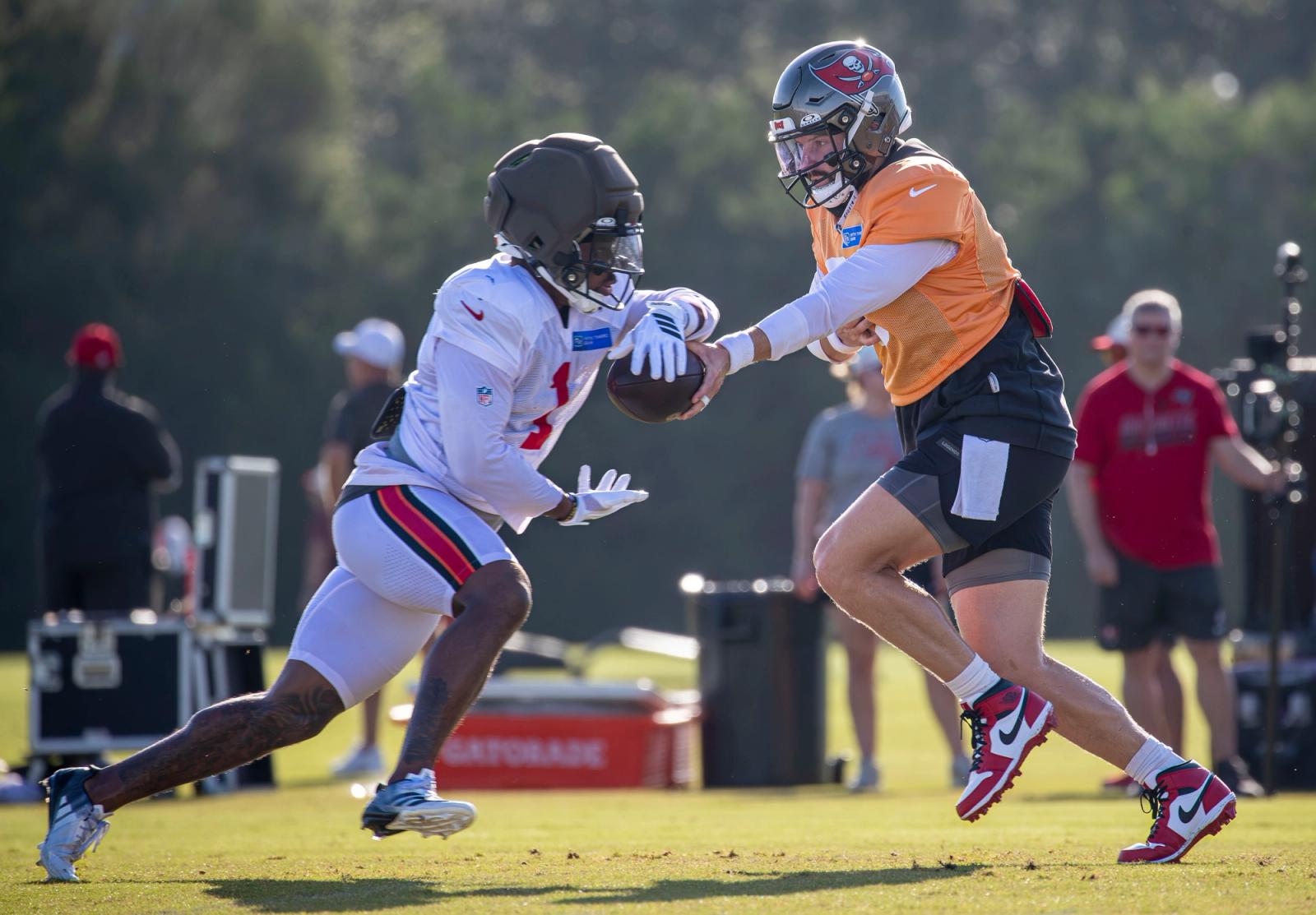
Red-zone periods naturally amplify individual plays because space becomes compressed and mistakes become touchdowns. A safety beating the offense to the point of attack and erasing a running play does more than win one snap. It can reveal something about recognition, physicality and willingness to attack downhill.
Nobody is rewriting Tampa Bay’s defensive plans because Smith stopped one run in August, but these are the reps coaches can actually use.
The larger complication in evaluating Tampa Bay’s defense remains Wirfs’ absence.
His hamstring injury affects more than the offensive line. It changes the level of competition Tampa Bay’s pass rush sees every day and creates an important asterisk around plays such as Walker’s would-be sack.
That does not make Walker’s production meaningless. It simply means coaches need to evaluate how he is winning, not merely whether he reaches the quarterback.
His eventual opportunities against better tackles, whether Wirfs when healthy or opposing linemen during joint practices, should provide a considerably better measuring stick.
Cornerback Benjamin Morrison presents a different issue.
Morrison has been dealing with a hamstring injury dating back to minicamp and remains unavailable.
Bowles previously expressed hope that Morrison might be able to participate in some capacity during Tampa Bay’s upcoming joint practices with the New York Jets, but the latest update offered little change.
“He’s the same as usual,” Bowles said.
That leaves the Buccaneers in a holding pattern.
There is no reason to manufacture a recovery timeline the team has not provided. Morrison is injured, his status has not meaningfully changed and everything beyond that would be guesswork.
What is clear is that every practice missed is another evaluation opportunity lost and another rep available to somebody else in Tampa Bay’s secondary.
This is the dangerous part of training camp.
Hurst makes two spectacular catches and suddenly somebody wants to rearrange the receiver depth chart.
Walker spends nine practices in the backfield and somebody starts calculating double-digit sacks.
Godwin looks healthy and suddenly everyone forgets that remaining healthy through an NFL season is a very different challenge from looking sharp during camp.
There are meaningful developments here.
Hurst earning first-team work is real.
Walker repeatedly creating disruption is real.
Godwin moving around the formation and participating at a level that has Bowles publicly praising his health is real.
Houston using increased opportunities to make legitimate plays is real.
But “real” does not mean permanent.
Training camp provides evidence, not verdicts.
The next stage is seeing whether these performances survive changes in circumstance.
Can Hurst continue producing when the receiver room gets healthier and repetitions become more competitive?
Can Walker generate the same pressure when Tampa Bay’s offensive line improves or when he sees unfamiliar tackles?
Can Houston’s speed translate into enough offensive and special-teams usefulness to matter during roster construction?
Can Morrison get healthy enough to create his own evaluation tape before the decisions become more urgent?
Those questions are considerably more important than declaring winners after one practice.
Tampa Bay’s upcoming joint work with the New York Jets arrives at an ideal point in that evaluation process.
Familiarity can distort camp. By now, Buccaneers defenders have seen the same offensive concepts repeatedly, while the offense has spent weeks learning how Tampa Bay’s defense wants to attack it.
Joint practices change that.
Different coverage techniques. Different pass-rush plans. Different receivers. Different tackles. Different communication problems.
For Hurst, it means an opportunity to prove his recent success is not dependent on repeatedly seeing the same defensive backs.
For Walker, it provides another set of offensive linemen to test the legitimacy of his impressive run.
For Houston, it is another chance to make his speed matter against unfamiliar coverage.
And for Morrison, assuming his hamstring allows him to participate, it could represent an important step back into meaningful competition.
There will still be August noise. There always is.
But Tampa Bay is beginning to accumulate enough evidence around a few players that certain storylines deserve to graduate from camp curiosity to legitimate preseason questions.
Hurst is one of them.
Walker is another.
Godwin’s health might be the most important of all.
The Buccaneers do not need any of those stories decided today. They just need the next practice to provide another piece of evidence.
That is what training camp is supposed to be.
Not a place where stars are created overnight, but where players slowly make it harder for coaches to ignore them.
Right now, Ted Hurst III is doing exactly that.